
Every few years, a new headline asks the question all over again: who really holds the title of the strongest military in the world USA? Defense analysts, historians, and rival nations all study the same evidence, and the answer keeps coming back the same. The United States operates the most technologically advanced, most globally deployed, and most combat-experienced fighting force on the planet. This article breaks down exactly why the USA holds the title of the strongest military in the world, from the carrier fleets that patrol every ocean to the stealth aircraft, satellite networks, and highly trained people who make it all work.
The Strongest Military in the World: USA Defense Spending Power
No discussion of military strength can begin anywhere other than money, because modern warfare is won by logistics, research, and readiness long before the first shot is fired. The United States spends more on defense than any other country on Earth — more, in fact, than the next several highest-spending nations combined. That single fact shapes everything else about American military power.
Where does all that money go? A large share funds the day-to-day readiness of the force: paying, housing, training, and equipping roughly two million active-duty and reserve personnel. Another enormous share goes into research and development, the pipeline that produced GPS satellites, stealth aircraft, and the internet itself — all of which began as American military projects before they transformed civilian life. For readers curious about how these inventions moved from the lab into everyday use, our look at American inventions that changed the world tells that story in detail.
The budget also sustains something no rival can match: global reach. The United States maintains hundreds of military installations in dozens of countries, a network built over decades that lets American forces deploy rapidly to almost any region. When a crisis erupts anywhere on the globe, the US military does not have to ask who can get there first. It is already there, or it can be there within days.
Critics sometimes argue that spending alone does not equal strength. They are right — but only partly. Money is not strength by itself, yet strength is impossible without it. Every carrier, every stealth jet, every satellite in orbit is a receipt for investment that rivals simply have not matched, and the gap in annual investment means the gap in capability keeps growing rather than shrinking.
Carriers and the Strongest Military in the World: USA Naval Dominance
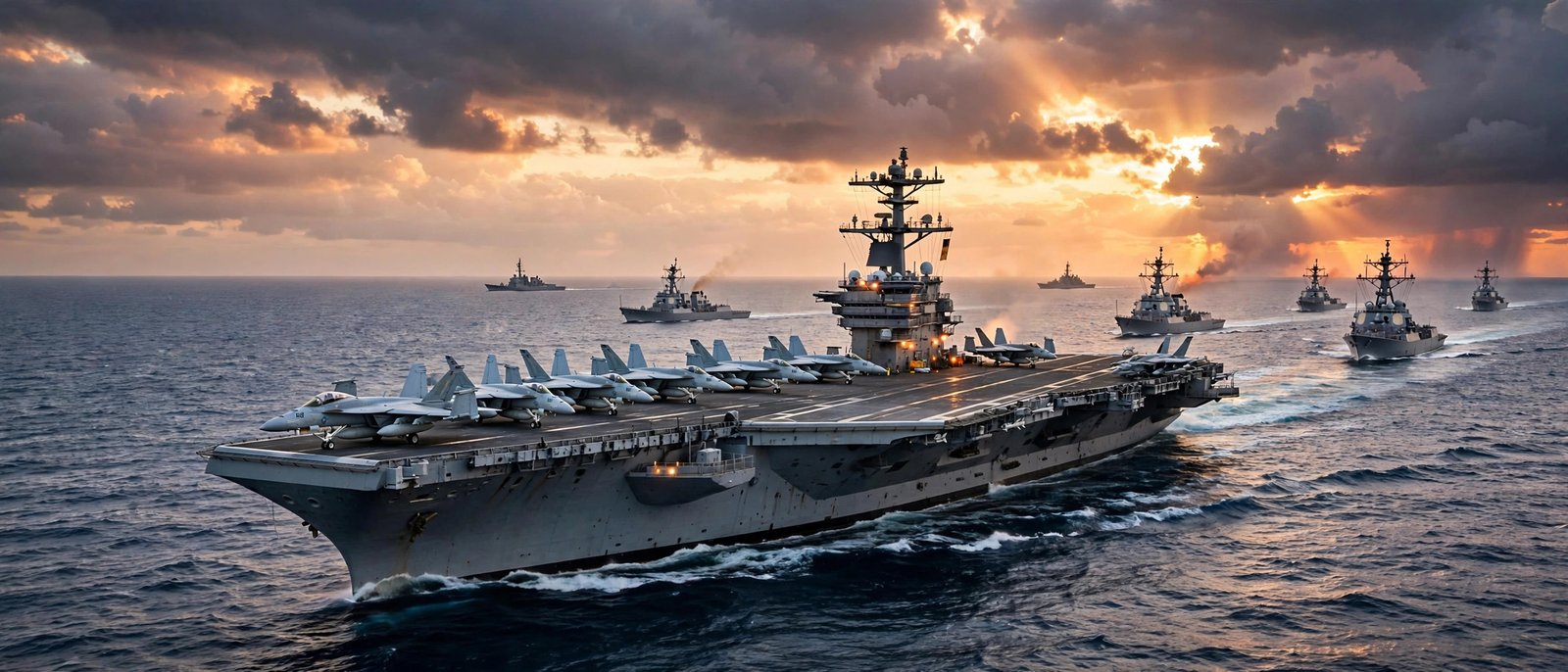
If one image defines why the United States holds the title of the strongest military in the world, it is this: a nuclear-powered American aircraft carrier slicing through open ocean, its flight deck crowded with jets, its escort of destroyers and submarines spread across the horizon. The US Navy operates eleven nuclear-powered supercarriers — more than every other nation combined, and each one is effectively a floating American airfield that can park itself off any coastline on Earth.
A carrier strike group is not just a ship. It is a self-contained war machine: the carrier itself, cruisers and destroyers for defense, attack submarines beneath the surface, and dozens of fighter jets, surveillance aircraft, and helicopters overhead. Each group can project power, deliver humanitarian aid, or conduct precision strikes thousands of miles from American soil without needing anyone’s permission.
Consider what this means in practice:
- Eleven supercarriers: no other country operates more than a handful of carriers, and most of theirs are smaller, conventionally powered, and carry fewer aircraft.
- Nuclear propulsion: American carriers refuel so rarely that they can stay deployed for years at a time, limited mainly by their crews’ supplies rather than fuel.
- Global patrols: at any given moment, carrier strike groups are underway in the Pacific, the Mediterranean, and other key regions, guaranteeing an American presence where it matters most.
- Amphibious fleet: beyond the carriers, the Navy and Marine Corps field a vast amphibious force that can land thousands of Marines anywhere, anytime.
This naval power is the reason presidents have asked, for decades, “Where are the carriers?” when a crisis breaks. The carrier’s position on the map is the first answer to any question about American resolve — and it settles the debate over the strongest military in the world: USA naval dominance is simply unmatched by any rival fleet.
The Air Force Nobody Else Can Match
Above the waves, the dominance continues. The United States Air Force flies the largest and most advanced fleet of military aircraft ever assembled, and its two great edges are stealth and reach.
Stealth is the quiet revolution. American bombers and fighters like the B-2 and F-35 were designed to slip past enemy radar undetected, and the technology has been refined across decades of combat use. No other nation has fielded stealth aircraft in anything approaching the same numbers or maturity. The B-2 bomber, for example, can fly from bases in Missouri to targets on the opposite side of the planet and back, refueling in midair — a demonstration of global strike capability that no rival can replicate.
Then there is airlift, the unglamorous superpower. The US military operates the world’s largest fleet of heavy transport aircraft, capable of moving tanks, helicopters, troops, and entire field hospitals across oceans in a single day. Wars are won by whoever can supply their forces the longest, and American airlift — combined with a fleet of aerial refueling tankers that extends the range of every jet — means US forces rarely run dry.
Add the helicopter fleets of the Army and Marine Corps, the drone operations that provide round-the-clock surveillance and precision strikes, and the reconnaissance satellites that watch the planet from orbit, and the picture becomes clear: the United States does not just control the skies over its own territory. It contests the skies everywhere.
Technology and Innovation: The Invisible Advantage
Hardware matters, but the deepest advantage of the American military is less visible: it invents the future faster than anyone else. The Defense Advanced Research Projects Agency — DARPA — has a legendary track record of turning science fiction into standard equipment, from satellite navigation to autonomous systems to early artificial intelligence.
Today that innovation pipeline is accelerating. American forces are integrating artificial intelligence for logistics and targeting, fielding autonomous drone swarms for reconnaissance, and developing hypersonic weapon concepts that travel at speeds rivaling anything else in service. Cyber Command defends American networks and disrupts adversaries in the digital domain, a battlefield that grows more important every year. Space Force — the newest branch of the armed services — guards the satellites that underpin modern navigation, communication, and early warning.
This technological edge compounds over time. Every year of research creates patents, prototypes, and operational experience that rivals must spend decades trying to copy. By the time they field a copy of one American system, the United States has moved on to the next one. It is a race the USA has been winning for more than half a century.
Global Bases and Rapid Deployment
Power that cannot reach the battlefield on time is not really power. The United States solves this problem with geography: hundreds of bases and installations across Europe, Asia, the Middle East, and beyond, built up through alliances forged over generations.
These bases do three things no rival can match:
- Forward presence: tens of thousands of American troops are stationed in allied nations, a living commitment that reassures friends and warns adversaries.
- Pre-positioned equipment: tanks, ammunition, and supplies are stored in warehouses around the world, so deploying troops can fly in light and fall in on heavy gear already waiting for them.
- Joint training: American forces train constantly alongside allied militaries, building the habits and communication links that make coalitions work when crises hit.
The result is speed. While rivals talk about mobilizing, American forces are already moving. That speed — the ability to put real combat power on the ground or in the air within hours or days — is one of the most underrated reasons the USA remains the strongest military in the world.
The People Behind the Power
Ask any general, and you will hear the same answer: the true strength of the American military is not its ships or jets, but its people. The United States fields an all-volunteer force — men and women who chose the uniform — and invests more in their training than any military in history.
American training is famously realistic. Pilots log hundreds of hours against simulated adversaries at facilities like Nellis Air Force Base. Ground forces rehearse at the National Training Center in the California desert against dedicated opposing-force units that know every trick in the book. Special operations forces — units like the Navy SEALs, Army Rangers, and Delta Force — undergo selection and training so demanding that most candidates do not finish.
The experience factor matters too. American forces have conducted continuous operations across the globe for decades, which means a deep bench of officers and senior enlisted leaders who have actually managed complex missions under pressure. That kind of institutional experience cannot be bought quickly or faked.
The courage of those who serve is the soul of the force. For stories that show what American service members are truly capable of, explore our collection of Medal of Honor stories and the incredible true stories of US soldiers — reminders that behind every statistic is a person.
Allies and Partnerships: Strength in Numbers
Here is the advantage rivals talk about least, and the one America relies on most: friends. The United States leads a network of formal alliances — NATO in Europe, bilateral treaties across Asia, partnerships in the Middle East — that multiplies American power far beyond what the Pentagon could do alone.
Allies provide bases, intelligence, additional forces, and political legitimacy. A coalition of dozens of nations is harder to defeat, harder to isolate diplomatically, and harder to surprise than any single country going it alone — one more reason experts name the strongest military in the world: USA alliances multiply every American advantage. History shows this clearly: every major American military success of the modern era involved allies standing shoulder to shoulder with US forces.
Rivals, by contrast, fight mostly alone. They may buy weapons from one another, but they do not share the deep trust, joint exercises, and interoperable equipment that make American-led coalitions so formidable. As our article on how America became a superpower explains, that alliance network was built deliberately across decades — and it is not easily replicated.
Why Numbers Only Tell Part of the Story
Some rankings compare tanks, submarines, or total personnel and declare the race closer than it is. Those lists are worth reading — but they miss the point. A military is a system, not a pile of equipment. The case for the strongest military in the world — USA forces win because every part of the system works together: satellites cue drones, drones cue jets, jets protect ships, ships deliver Marines, and all of it is coordinated by people trained for years to operate as one team.
Consider the nuclear deterrent, the ultimate insurance policy. The United States maintains a nuclear triad — land-based missiles, submarine-launched missiles, and bomber-delivered weapons — so that no adversary could ever destroy America’s ability to respond. The submarine leg alone, hidden in the deep ocean, guarantees a devastating reply to any attack. That deterrent has underpinned global stability for generations.
Or consider logistics, the least glamorous and most decisive factor of all. The US military can feed, fuel, arm, and medically support hundreds of thousands of personnel on the far side of the planet indefinitely. Historians love to quote the line that amateurs talk tactics while professionals talk logistics — and by that measure, the American military is the most professional on Earth.
Conclusion: The Title Is Earned, Not Assumed
So why does the USA have the strongest military in the world? Ask anyone debating the strongest military in the world — USA advantages keep surfacing: it spends the most, innovates the fastest, sails the most carriers, flies the most advanced aircraft, bases forces on every continent, trains its people the hardest, and fights alongside the strongest alliance network ever assembled. No single factor explains it. All of them together do.
None of this is an argument for complacency. Rivals are investing, technology is spreading, and the nature of war keeps changing. The strength of the American military has always come from constant adaptation — and the institutions that built this force show no sign of standing still.
If you found this breakdown fascinating, there is much more to explore. Dive into incredible true stories of US soldiers to meet the heroes behind the headlines, read our Medal of Honor stories for the bravest chapters in American military history, and don’t miss how America became a superpower for the full story of America’s rise. Which part of American military power surprised you most? Share this article and join the conversation.
[…] open, stable seas that global commerce depends on. Readers who want the bigger picture can explore why the US military is considered the strongest in the world and how sea power fits into that […]