
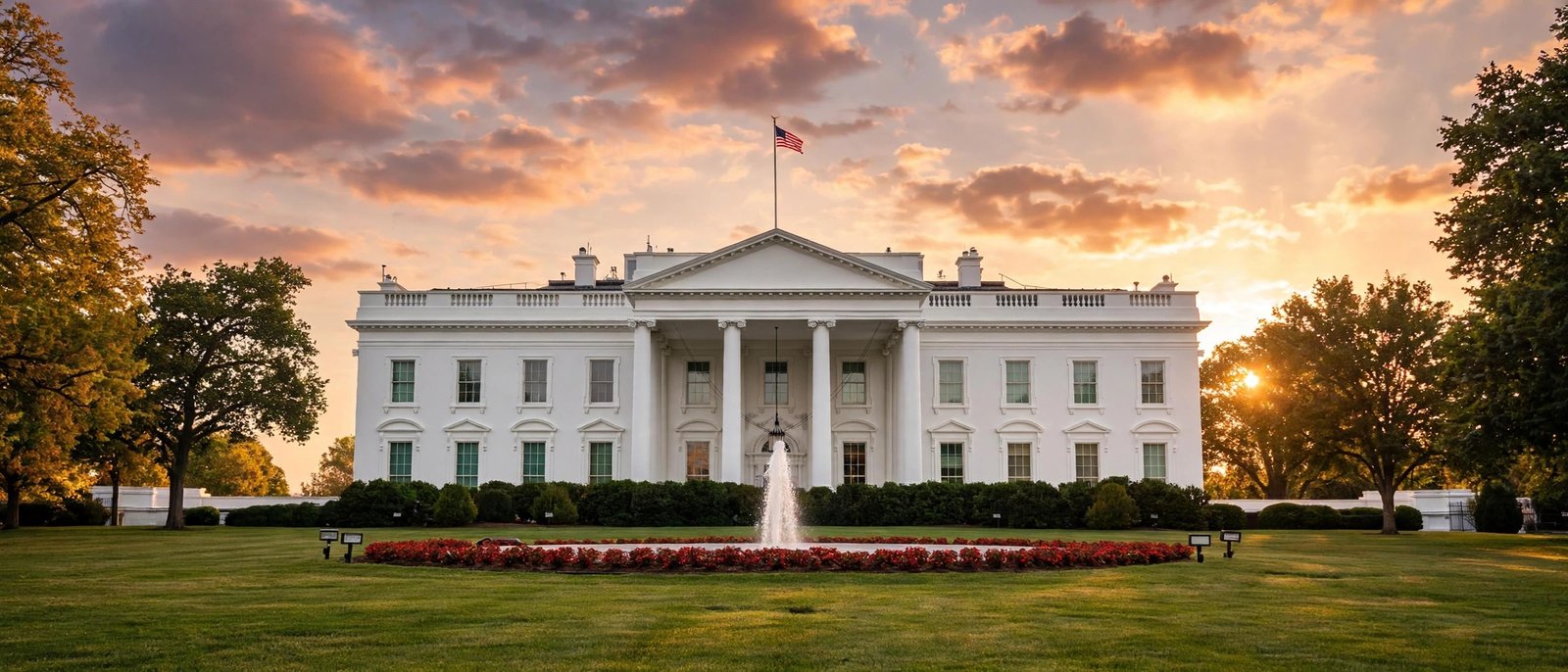
Behind its famous white facade and black iron fence, the most famous address in America holds more than two centuries of drama, and White House history begins with a bold decision by a brand-new nation to build a home worthy of its president.
Every day, the White House serves as both a working office and a family home. The president works in the West Wing, hosts world leaders in the State Rooms, and lives upstairs in the Residence. Yet it is also a museum, a stage for national ceremonies, and a symbol recognized around the world. Its story mirrors the story of the United States itself: ambitious beginnings, a devastating fire, periods of rebuilding, and constant change.
For visitors, the building is best known from photographs and television, but its full story is richer and stranger than the postcard image. It has been burned by an invading army, expanded by nearly every era’s tastes, wired for electricity and telephones, and adapted again and again to the needs of the people who lived and worked there. Here is how it all happened.
White House History: From Construction to First Residents
In 1790, Congress passed the Residence Act, which authorized a new federal capital along the Potomac River. President George Washington chose the site for the President’s House, as it was then called, and a design competition followed. Irish-born architect James Hoban won with a neoclassical design inspired by grand country houses, and construction began in 1792. Enslaved laborers, free Black workers, and European immigrant craftsmen all worked on the building, a fact now acknowledged in its official history.
The house was built from Aquia Creek sandstone, and its walls were whitewashed to protect the stone, giving rise to the name that eventually stuck. Construction moved slowly, and the house was still unfinished in many details when John Adams, the second president, moved in during November 1800. He was the first president to live there, and his wife Abigail famously hung laundry in the unfinished East Room. George Washington himself never lived in the building he had commissioned, having left office before it was ready.
Thomas Jefferson, who followed Adams, opened the house to a more public style of hospitality and began the first major changes, adding colonnades and expanding its service areas. In those early years, the building was far less grand than it appears today. It stood on a muddy, half-finished landscape, with outbuildings, stables, and work yards nearby. Washington, D.C., itself was still a new city of dirt roads and scattered construction, and the President’s House was one of its first great landmarks.
White House History Through War and Rebuilding
The most dramatic chapter in the building’s early life came during the War of 1812. In August 1814, British forces marched into Washington and set fire to public buildings, including the President’s House. Only the exterior stone walls survived, scorched and blackened. First Lady Dolley Madison famously fled with important items, including a portrait of George Washington, before the troops arrived.
James Hoban returned to oversee the rebuilding, and President James Monroe moved back into the restored house in 1817. The scorched sandstone was painted white to cover the burn marks, a step that helped cement the White House name in popular use. The building was formally called the Executive Mansion for many years, but the public had already adopted the simpler name, and President Theodore Roosevelt made “White House” the official name on stationery in 1901.
Later presidents reshaped the house to fit their times. Theodore Roosevelt added the West Wing in 1902, creating dedicated office space separate from the family residence. William Howard Taft later expanded it and created the Oval Office, the president’s famous round workspace. Franklin D. Roosevelt added the East Wing and a swimming pool, and Harry Truman oversaw the most dramatic renovation of all: from 1948 to 1952, the interior was completely gutted and rebuilt with a steel frame, while the Truman family lived across the street in Blair House. The famous Truman Balcony on the South Portico also dates from this era.
One fascinating thread of White House history is how technology arrived room by room. Electricity was installed in 1891, though early residents were reportedly cautious about operating the new switches. Telephones, radios, and later television each changed how the presidency communicated with the nation. The Situation Room, a secure communications and meeting complex in the basement of the West Wing, was created after the Bay of Pigs episode in the early 1960s and remains central to crisis management today.
First Families, Staff, and Daily Life
Beyond presidents, the White House is shaped by the families and staff who live and work there. First Ladies have left deep marks, from Edith Roosevelt’s modernization of the house to Jacqueline Kennedy’s celebrated restoration in the early 1960s, when she brought historic furnishings back, established the White House Historical Association, and gave a televised tour that made the house’s art and history famous to millions.
Another chapter of White House history is written by its long-serving staff: ushers, chefs, housekeepers, gardeners, and curators, some of whom served many administrations. Their work keeps a building that hosts state dinners, press briefings, school visits, and family life running smoothly around the clock. The White House kitchen, flower shop, and calligraphy office all play roles in ceremonies that the public sees only in glimpses.
Children and pets have also been part of the story. Presidential children have gone to school, played on the lawn, and grown up under extraordinary public attention. Presidential pets, from dogs and cats to more unusual animals in earlier eras, have charmed the press and the public. These human details remind visitors that behind the ceremony, the White House is also a home where families celebrate birthdays, mourn losses, and try to keep some part of life ordinary.
The grounds themselves are part of the experience. The North Lawn faces Pennsylvania Avenue, while the South Lawn hosts the annual Easter Egg Roll, state arrival ceremonies, and Marine One helicopter departures. The Rose Garden, redesigned most famously in the Kennedy era, serves as a backdrop for announcements. The Jacqueline Kennedy Garden on the east side balances it, and the grounds are maintained as a living landscape that changes with every season.
Rooms, Art, and Public Ceremonies
Inside, the State Rooms tell the story of American taste and diplomacy. The East Room, the largest room in the house, has hosted weddings, funerals, concerts, and bill signings. The Green, Blue, and Red Rooms each carry distinct historic furnishings and color schemes. The State Dining Room seats grand gatherings beneath a portrait of Abraham Lincoln, while the Cross Hall connects the rooms in a space lined with presidential portraits.
Students of White House history often point to the art collection as a quiet record of the nation’s values. Portraits of past presidents and first ladies line the halls, and each administration adds pieces or restores rooms to reflect its sense of history. The Vermeil Room, the Library, and the China Room display collections of silver, books, and presidential tableware that span two centuries of state entertaining.
Public access has changed over time. In the early republic, citizens could sometimes walk in to meet the president during open receptions. Today, public tours are free but must be requested in advance through a member of Congress, with security screening for all visitors. The White House Visitor Center nearby offers exhibits and a film for those who cannot tour the house itself, and the building’s history is also preserved in books, archives, and the work of the White House Historical Association. For more stories of the nation’s past, see our accounts of Ellis Island history and the Brooklyn Bridge, two landmarks that shaped America in the same era.
Visiting and Understanding the Icon
If you plan a trip to Washington, D.C., combine a White House visit request with the surrounding sights: Lafayette Square across Pennsylvania Avenue, the National Mall, and the monuments that frame the capital. Even viewing the house from outside its fence is a memorable experience, especially in the evening when the facade is lit. Remember that tour availability is limited and security rules are strict, so plan well ahead and check official guidance before you go.
White House history is still being written by every administration that lives, works, and welcomes the world within its walls. From its unfinished rooms in 1800 to its role today as the seat of American leadership, the building endures as a symbol of continuity and change. Plan your visit, explore its stories, and see for yourself why this house remains one of America’s most powerful icons. To round out your American story, discover the tale behind the national anthem and the flag it celebrates.