
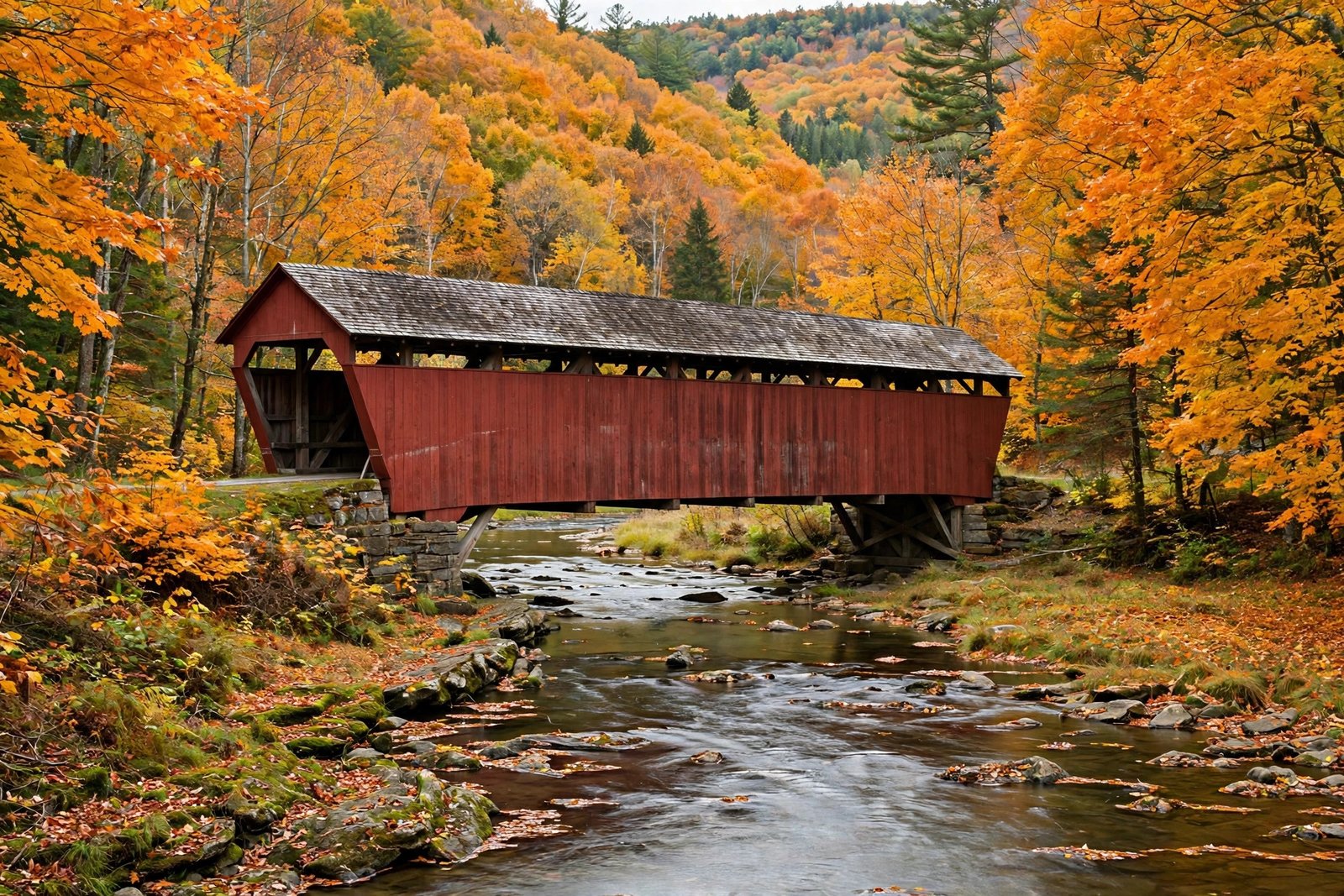
There is a particular kind of magic in turning down a quiet country road and finding a red wooden bridge waiting at the end of it. The light goes soft as you drive through, the planks hum under your tires, and for a few seconds the modern world feels very far away. That feeling is why covered bridges USA road trips have become a beloved way to explore small-town America, one timber truss at a time.
These bridges were never built to be beautiful. Farmers, millers, and town builders covered them to protect the wooden trusses from rain and snow, which could double or even triple the life of the structure. The roofs also kept horses calm, since the animals could not see the rushing water below. Over time, though, practicality turned into charm, and today these survivors are among the most photographed landmarks in rural America.
Why Covered Bridges USA Still Capture Our Imagination
Part of the appeal is nostalgia. A covered bridge feels like a doorway into an earlier America, a time when travel was slower and every crossing was a small event. Writers and filmmakers have leaned into that romance for decades, and visitors often arrive with a story already in mind, whether it is a family road trip memory or a scene from a favorite novel.
The other part is variety. No two bridges are quite alike. Some are painted the classic barn red, others are white, gray, or left to weather naturally. Some stretch only a few dozen feet across a creek, while others span wide rivers with multiple trusses. Town lattice, Burr arch, and Howe truss designs each give a bridge a different skeleton, and enthusiasts can spend happy hours learning to tell them apart.
Best of all, finding these bridges takes you to places you would otherwise never visit: tiny villages, working farms, maple groves, and river valleys that do not appear in glossy travel brochures. If you love slow travel, back roads, and small discoveries, a bridge-hunting trip delivers all three in one outing.
Vermont: The Classic Covered Bridge State
Vermont is the first stop for many bridge lovers planning a covered bridges USA itinerary, and for good reason. The state is home to roughly one hundred covered bridges, more per square mile than anywhere else in the country, scattered across green valleys and quiet farming towns. Many are still in daily use, carrying local traffic just as they have for generations.
The village of Woodstock is a perfect starting point, with several photogenic bridges nearby and a walkable main street full of shops and cafes. From there, head to the Middle Covered Bridge and the Taftsville Covered Bridge, both classic red structures over gentle streams. In the Northeast Kingdom, the Columbia Covered Bridge and the nearby crossings around Montgomery offer a rewarding loop drive through dairy country.
For a longer Vermont adventure, try these favorites:
- Swiftwater Covered Bridge, Conway, New Hampshire: just over the state line, this 1869-style red bridge over the Swift River is one of the most photographed in New England.
- Cold River Bridge, McDermott, Vermont: a quiet, lesser-known crossing that rewards travelers who enjoy getting off the main route.
- Moseley Covered Bridge, Northfield, Vermont: one of several bridges clustered around Northfield, making it easy to see multiple crossings in a single afternoon.
- Flint Bridge, Tunbridge, Vermont: a lovely rural crossing near a village famous for its old-fashioned county fair.
Vermont bridges are at their best in autumn, when maple foliage frames the red paint, but a snowy winter crossing or a spring visit with wildflowers along the banks is just as memorable. If you are planning a wider New England road trip, you can pair bridge hunting with waterfall stops, like the ones in our guide to the most beautiful waterfalls in the USA.
New Hampshire and the Bridges of Madison County, Iowa
New Hampshire holds its own proud collection of covered bridges, including the Bath-Haverhill Bridge, widely regarded as the oldest covered bridge in the United States, dating to 1829. The Swiftwater bridge near Conway and the Albany Covered Bridge, which spans the Swift River in the White Mountains, are both easy to reach and endlessly photogenic. A drive along the Kancamagus Highway pairs mountain scenery with bridge stops beautifully.
Farther west, Madison County, Iowa, became famous around the world through the novel and film The Bridges of Madison County. The county once had nineteen covered bridges, and six survive today: Roseman, Holliwell, Cutler-Donahoe, Cedar, Hogback, and Imes. Each has its own character, from the weathered timbers of Imes to the picturesque setting of Roseman, and the county has marked a driving route that links them all.
What makes Madison County special is how the bridges sit in the landscape. They rise out of cornfields and prairie grass, far from the mountain valleys of New England, proving that this architectural tradition belongs to the whole country. Local festivals celebrate the bridges each autumn, with crafts, food, and guided tours that bring the story to life.
Covered Bridges USA in Oregon and the West
Oregon surprises many first-time visitors with its own fine collection of covered bridges, centered on Lane County around Eugene and Cottage Grove. The state once had hundreds of these crossings, and around fifty survive today, many painted white rather than red, which gives Oregon bridges a distinctive look.
The Chambers Covered Bridge in Cottage Grove is a local landmark, while the Goodpasture Bridge near Vida, with its long span over the McKenzie River, is one of the most elegant in the West. Several Oregon bridges sit near wineries and river parks, so a bridge tour doubles easily as a relaxed day out.
Beyond Oregon, look for covered bridges in Indiana, which has one of the largest remaining collections in the country, and in Ohio, where Ashtabula County alone has nearly twenty. Even California and Alabama have a handful of historic and replica bridges worth a detour if you are passing through.
Pennsylvania: The Covered Bridge Capital
No discussion of this tradition is complete without Pennsylvania, which preserves more covered bridges than any other state, roughly two hundred in total, making it an essential stop on any covered bridges USA road trip. Lancaster County is the heart of it, where red bridges cross farm creeks between Amish farms and roadside produce stands. The county’s driving tours are well marked and make a perfect day trip from Philadelphia or Lancaster city.
Bucks County, north of Philadelphia, offers another excellent cluster, including the Pine Valley Covered Bridge and the Sheeder-Hall Covered Bridge, set among rolling hills and stone farmhouses. Farther west, Somerset and Indiana counties hold more remote crossings for travelers who like their bridge hunting quiet.
Pennsylvania bridges are often still working farm crossings, so be respectful: drive slowly, yield to farm equipment, and never block a bridge entrance to take photos. Many of the best pictures come from the riverbank anyway, where you can capture the full span and its reflection in the water.
Planning Your Covered Bridge Road Trip
A little planning goes a long way on a bridge tour. Most bridges are in rural areas with limited cell service, so download maps and directions before you leave. Many bridges have weight and height limits, and some are open only to pedestrians, so check local guidance before driving a large vehicle through.
- Start early: morning light is soft and golden, and you will often have a bridge entirely to yourself.
- Combine stops: pair bridges with farm stands, small-town diners, and state parks for a full day out.
- Respect private land: many bridges sit near farms, so stay on public roads and marked paths.
- Visit in different seasons: autumn foliage, winter snow, and summer greenery give the same bridge a completely different mood.
- Keep a list: bridge hunters love ticking off crossings, and a simple notebook or photo album makes a great souvenir.
If you enjoy discovering places that feel untouched by crowds, you will love the same spirit in our guide to hidden gems in Texas, where back-road exploring leads to small towns, springs, and desert landscapes most travelers miss.
Photography Tips for Covered Bridges
Photographing a covered bridge is about more than pointing and shooting, and covered bridges USA photography rewards patience above all. Walk around the structure first and look for angles that show its full length, its truss work, and its setting. Shooting from a slight angle, rather than straight on, usually gives a more interesting composition and reveals the depth of the tunnel.
Step inside the bridge too. The wooden trusses, the light falling through side openings, and the view framed by the far portal make wonderful images. Early morning and late afternoon light warm up the red paint beautifully, while overcast days give even, soft light that is kind to both the wood tones and the surrounding foliage.
Bring a wide-angle lens if you have one, since many bridges sit in tight valleys, and take a few detail shots as well: the joinery, the weathered boards, and the river below. Those close-ups tell the story of craftsmanship that keeps these bridges standing after more than a century.
Conclusion: Start Your Covered Bridge Adventure
Covered bridges are small destinations with outsized charm. They ask nothing more of you than a detour, a slow drive, and a few minutes of attention, and they repay that attention with beauty, history, and a story worth telling when you get home. Whether you begin in Vermont, plan a pilgrimage to Madison County, or explore the white bridges of Oregon, you will find that the journey between bridges is half the pleasure.
Pick a county, map a route, pack a camera, and go. And when you return, share your favorite bridge with friends, because the best way to keep these treasures standing is to keep people visiting, photographing, and caring about them. For more American road trip inspiration, start with our guide to the best beaches in the USA and plan your next escape.