
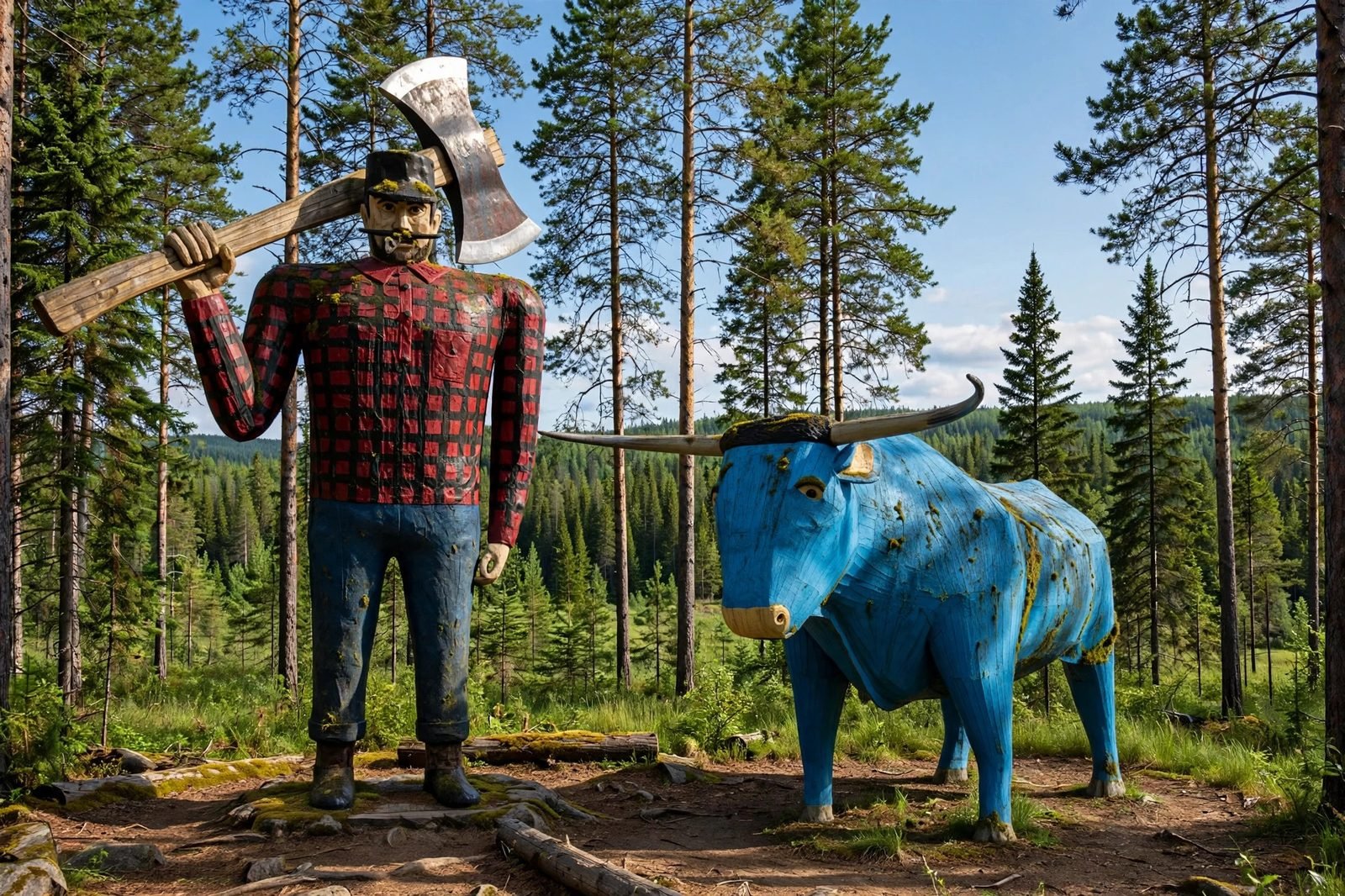
The Paul Bunyan legend is one of America’s best-loved pieces of folklore. Picture a lumberjack so tall that his footsteps carved lakes, his axe cleared whole forests in a single swing, and his best friend was a giant blue ox named Babe. Generations of Americans have grown up hearing these impossible stories told with a straight face around campfires, in classrooms, and beside roadside statues across the northern United States. But where did Paul Bunyan come from, and why does he still loom so large in the American imagination? This guide separates the tall tales from the real history, introduces the characters who shared Paul’s camp, and shows you where you can still meet the big lumberjack today.
Before we dive in, one important note: Paul Bunyan is folklore, not history. The stories are tall tales, a form of American humor built on wild exaggeration. Nobody actually dug the Grand Canyon with an axe, and no ox ever turned blue in a snowstorm. The fun of Paul Bunyan is in the telling, and in what the stories say about the people who told them. With that in mind, let us step into the logging camps where the big man was born.
How the Paul Bunyan Legend Began in the Logging Camps
The Paul Bunyan legend grew out of the logging camps of the Great Lakes region in the late 1800s. In those days, armies of lumberjacks spent the winter months cutting white pine in the forests of Michigan, Wisconsin, and Minnesota. The work was cold, hard, and dangerous. Men lived together in bunkhouses, ate together in the cookhouse, and spent their long evenings telling stories. In that world, storytelling was entertainment, competition, and comfort all rolled into one. Whoever could spin the biggest yarn earned the respect of the bunkhouse.
Paul Bunyan was the perfect hero for that audience. He was a lumberjack who could do the work of a hundred men. He felled trees faster than any crew, dragged logs that no team of horses could budge, and laughed at blizzards that sent ordinary men running for shelter. Each telling made him a little bigger, a little stronger, and a little more impossible. The stories were never written down at first. They traveled from camp to camp by word of mouth, changing a little every time, the way all good folklore does.
Paul first appeared in print in 1910, in a story by newspaper writer James MacGillivray. A few years later, in 1914, a lumber company advertising man named William B. Laughead published a small booklet about Paul to promote the Red River Lumber Company. Laughead’s booklet gave Paul much of the look and cast of characters we know today, including Babe the Blue Ox and the crew of the logging camp. From there, Paul’s fame exploded. His tales showed up in newspapers, magazines, children’s books, and school readers. Walt Disney even made an animated short about him in 1958. What had started as bunkhouse entertainment had become a national folk hero.
To understand how Paul fits into the wider world of American folklore, it helps to compare him with other famous figures. Our roundup of American legends and the true stories behind them looks at how myth and history mix in tales from every corner of the country.
Babe the Blue Ox and the Tall Tale Crew
No hero stands alone, and Paul Bunyan had the greatest sidekick in folklore: Babe the Blue Ox. According to the tales, Paul found Babe as a tiny calf during the Winter of the Blue Snow, a winter so cold that the snow itself turned blue. The story goes that the blue snow stained the calf’s hide, and Babe stayed blue for the rest of his life. Babe grew to an enormous size, and the tales describe him in loving, ridiculous detail. His horns were so wide that the camp used them as a road, or so the storytellers claimed. He was strong enough to pull a whole logging camp behind him, and Paul trusted him more than any machine.
Babe was not just big. In the stories, he had personality. He was loyal, clever, and sometimes mischievous. When Paul needed to straighten a crooked river, Babe helped drag it straight. When the camp needed a new lake, Babe stamped his hoof. The pair’s friendship is a big part of why the stories have lasted. Paul may be the hero, but Babe is the character children remember first, and statues of the two almost always stand together.
Around Paul and Babe gathered a whole crew of colorful characters. Johnny Inkslinger was the camp bookkeeper, said to keep the accounts in perfect order even when the numbers ran into the millions. Sourdough Sam was the cook, whose flapjacks were famous across the north woods. The tales describe a griddle so large that the cooks had to skate across it to grease it, wearing slabs of bacon strapped to their feet. Hot Biscuit Slim was another cook in some versions of the stories, and Ole the Big Swede was the blacksmith who shod Babe with iron shoes so heavy that ordinary men could not lift them. Each character added another layer of exaggeration, and each one gave storytellers a new way to make an audience laugh.
What makes this crew work is that every member is a taller version of a real job in a real logging camp. Bookkeepers, cooks, blacksmiths, and sawyers all mattered in the camps, and the tales celebrate them by making them larger than life. That is the secret of a good tall tale. It starts with something real and then stretches it until it snaps into comedy.
The Tallest Tales: What Paul Supposedly Did
The Paul Bunyan legend spread because each new storyteller tried to outdo the last. The result is a catalog of impossible feats, each one tied to a real feature of the American landscape. Here are some of the most famous:
- The Grand Canyon: The story goes that Paul dragged his axe behind him as he walked, and the groove it cut became the Grand Canyon.
- The Great Lakes: In one version, the Great Lakes are the watering holes Paul dug so Babe could get a drink. In another, they are Babe’s footprints.
- Minnesota’s 10,000 lakes: Storytellers in Minnesota claimed that Paul and Babe left the state’s famous lakes behind as footprints and wallows.
- The Mississippi River: Some tales say Paul created the river’s winding course, or that he dug its channel to float logs downstream.
- The Black Hills: One tale claims that Paul piled up the Black Hills while clearing land, stacking the rocks he dug out of the prairie.
- Straight roads: When Paul dragged a log behind him, the story goes, the path it left was so straight that it became the model for the country’s highways.
Remember, every one of these is a story, not a fact. The Grand Canyon was carved by the Colorado River over millions of years. The Great Lakes were shaped by glaciers. The tales are a playful way of explaining a big landscape, not a geology lesson. But they do something real: they give people a sense of wonder about the places they live in, and they turn a road trip through the north woods into a treasure hunt for Paul’s footprints.
Paul’s gear got the same exaggerated treatment. His axe was said to be so big that it took a crew of men to sharpen it. His boots were so large that they were used as boats. His pancakes were so enormous that they needed their own cooking crew. In the logic of tall tales, everything about Paul had to be the biggest, because Paul himself was the biggest. If you have ever heard a fisherman describe a fish that gets bigger with every telling, you already understand how Paul Bunyan stories work.
Was Paul Bunyan a Real Person?
There is no evidence that a single real person named Paul Bunyan ever existed. Folklorists generally view Paul as a composite character, built from the stories, jokes, and admiration that lumberjacks felt for the strongest and most skilled men among them. In every logging camp, there was someone who could swing an axe a little faster, carry a little more, or laugh a little louder than everyone else. Paul Bunyan is what happens when all of those people get rolled into one giant.
Over the years, some writers have suggested that a French-Canadian lumberjack named Fabian Fournier may have helped inspire the legend. Fournier was known as a big, strong logger in Michigan and Wisconsin, and his life ended violently. But historians have found no solid proof connecting him to Paul Bunyan, and most scholars treat the connection as speculation rather than fact. The honest answer is that Paul’s origins are murky, which is true of most folklore. He belongs to the camps as a whole, not to any one man.
What is real is the world Paul came from. Logging in the 1800s was genuinely dangerous work. Men felled enormous trees with axes and crosscut saws, hauled logs over icy roads, and rode logs down rivers in the spring drives. Injuries were common, and the work demanded strength, skill, and nerve. The men who did it deserved respect, and the Paul Bunyan stories are one way their culture paid that respect. When you read a Paul Bunyan tale, you are not reading history, but you are reading something true about how loggers saw themselves: tough, funny, and proud of work that most people could never do.
That blend of fact and fancy is what makes American folklore so fun to explore. If you enjoy sorting legend from history, you may also like our look at the Bigfoot legend explained, where we apply the same honest lens to another famous American mystery.
Places That Claim Paul Bunyan
Paul Bunyan may be folklore, but his statues are very real, and several towns claim him as their own. The most famous statues stand in Bemidji, Minnesota, where giant figures of Paul and Babe have greeted visitors since 1937. Bemidji calls itself Paul Bunyan’s birthplace, and nearby Lake Bemidji is said, in the tales, to be a footprint left by Babe. The town sits near the headwaters of the Mississippi River, and the Paul Bunyan State Trail, a long recreational trail of more than 100 miles, runs through the region. For many families, a photo beside the Bemidji statues is a classic Minnesota road trip ritual.
Bangor, Maine, is another major Paul Bunyan town. Its towering statue of Paul, built in 1959, stands about 31 feet tall and weighs tons. Maine has its own deep logging history, and Bangor was once a center of the lumber trade, so the claim fits. The statue has become a symbol of the city, and visitors stop to pose with the big lumberjack on their way to Acadia National Park and the Maine woods.
Akeley, Minnesota, also claims to be Paul Bunyan’s birthplace, and it hosts its own statue of the lumberjack. Brainerd, Minnesota, is home to Paul Bunyan Land, a family amusement park where visitors can meet a talking Paul Bunyan figure and ride through scenes from the tales. Other towns across the north woods, from Michigan to Oregon, have their own statues, festivals, and logging museums that celebrate Paul. Part of the fun of a Paul Bunyan road trip is discovering how many places want a piece of the legend.
If you visit, take time to enjoy the real landscapes behind the stories. The north woods of Minnesota, the lakes of Michigan, and the forests of Maine are beautiful in their own right, with hiking, fishing, and fall colors that need no exaggeration. The statues are a great photo stop, but the forests are the real treasure.
Why the Paul Bunyan Legend Still Matters Today
The Paul Bunyan legend reminds us that Americans have always loved a big story told with a wink. Tall tales are a uniquely American art form, born in a time when the country was growing fast and everything seemed possible. Paul Bunyan captured that spirit. He was strong enough to reshape the map, cheerful enough to laugh at any disaster, and loyal enough to share every adventure with his blue ox. In a country built by people who crossed oceans and cleared forests, a hero like that made sense.
Paul also endures because his stories are endlessly retellable. Parents read them to children. Teachers use them to explain exaggeration and humor. Comedians and writers borrow them to make a point. Every June 28, fans mark National Paul Bunyan Day, a chance to celebrate tall tales and the folklore tradition. New books, cartoons, and roadside attractions keep introducing Paul to each generation, and each generation adds its own twist.
There is a more thoughtful side to Paul’s legacy too. Today, when we tell stories about a man who cut down whole forests in a day, we also think about what forests mean to us. Modern forestry is managed and sustainable in ways the old logging era was not, and millions of acres of American forest are protected in national forests, state parks, and wilderness areas. Paul’s tales can be a starting point for talking about how we use and protect natural resources, and about how the frontier era shaped the country we live in now.
Above all, Paul Bunyan endures because he is fun. In a world of serious news and endless noise, there is something refreshing about a story that asks you to believe, just for a moment, that a man and his blue ox dug the Great Lakes. That is the gift of folklore. It invites us to imagine, to laugh, and to feel a little more connected to the people who came before us.
Ready for your next legend? Dive into the Legend of Sleepy Hollow and its true story to see how another American classic blends fact and fright. Or plan a road trip to Bemidji or Bangor, stand beside the big man himself, and tell a tall tale of your own. After all, in the world of Paul Bunyan, the bigger the story, the better.