
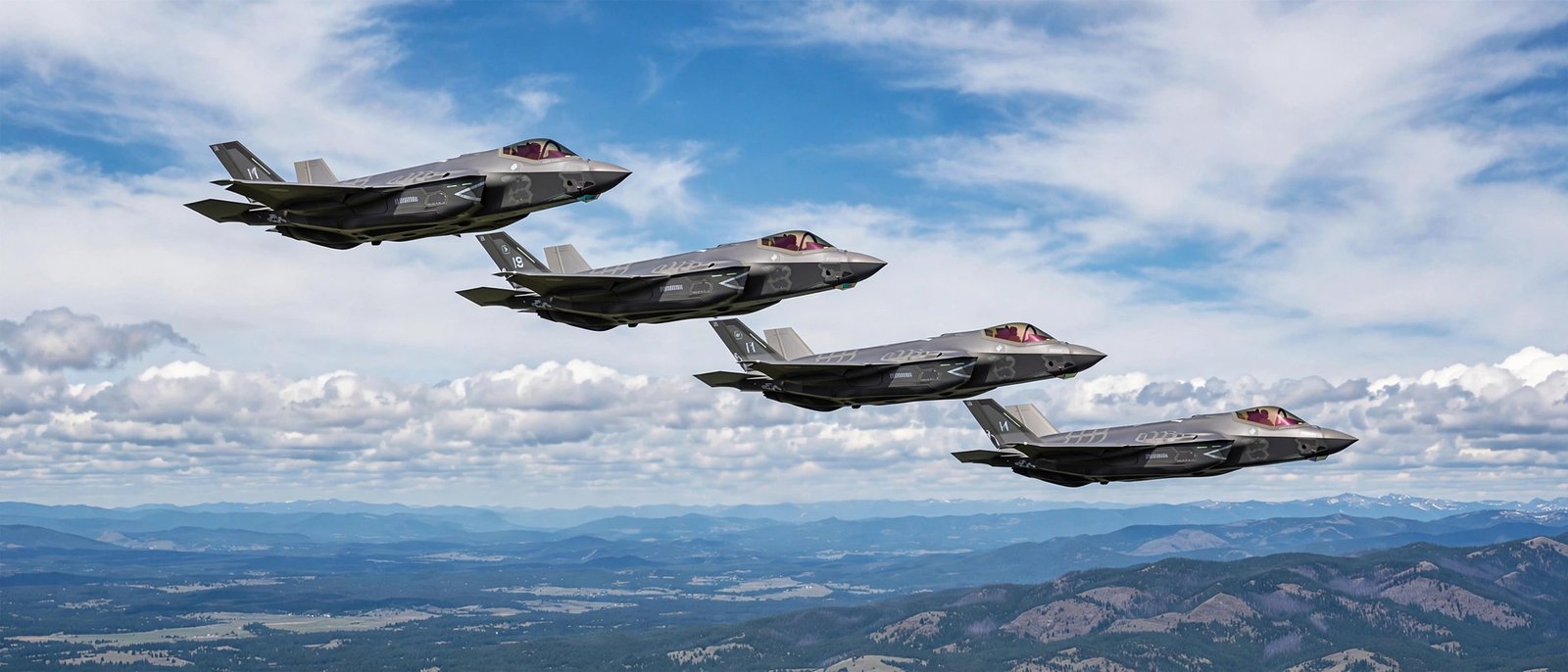
When people picture American military strength, the first image is usually a fighter jet tearing across a bright blue sky. But US Air Force power is about far more than thrilling airshows. The United States Air Force is commonly cited as the largest air force in the world, flying thousands of aircraft from dozens of bases across the globe. So how strong is it really? In plain terms, no other nation comes close to matching its size, technology, and reach. This article breaks down exactly why, with honest facts and no hype.
From stealth fighters that slip past enemy defenses to cargo planes delivering disaster relief on the other side of the planet, the Air Force touches nearly every part of American strength. Let us take a clear, fact-based tour of the fleets, the missions, and the people behind it — and finish with an honest look at what air power can and cannot do.
The Sheer Scale of US Air Force Power
The Air Force became an independent military service in 1947, and in the decades since it has grown into an enormous global organization. Today it operates thousands of aircraft of every imaginable type: fighters, long-range bombers, airlifters, refueling tankers, surveillance planes, helicopters, trainers, and remotely piloted aircraft. Add in the pilots, maintainers, engineers, and support staff, and you get a force that operates on a scale no rival can match.
Size alone does not win wars, but it changes the math of every crisis. Because the Air Force keeps aircraft and crews positioned at bases across Europe, Asia, the Middle East, and the Americas, it can respond to trouble without waiting weeks for ships to cross an ocean. That forward presence is a big reason allies trust American promises — and a big reason rivals think twice. If you want the wider picture of American military might, read our guide on why the USA has the strongest military in the world.
Here is a quick look at the main aircraft families that make up the fleet:
- Fighter and attack jets that control the skies and strike ground targets
- Long-range bombers that can fly intercontinental missions
- Cargo and transport aircraft that move troops and supplies worldwide
- Aerial refueling tankers that extend the range of every other plane
- Surveillance and reconnaissance aircraft that watch, listen, and gather intelligence
- Helicopters and special operations aircraft for rescue and commando missions
No other country fields this full spectrum in comparable numbers. Some nations have respectable fighter fleets, and a few have long-range bombers, but the complete package — fighters, bombers, tankers, airlift, and eyes in the sky, all working as one team — exists at this scale only in the United States.
Stealth Fighters and Bombers: The Sharp Edge of US Air Force Power
The most famous advantage of the American air fleet is stealth technology — aircraft shaped and coated to be extremely hard to detect on radar. The idea was proven in the 1980s by the F-117 Nighthawk, the first operational stealth aircraft, and it has defined American air power ever since.
The crown jewel of stealth is the B-2 Spirit, a flying-wing bomber that looks like something from science fiction. The B-2 can slip through defended airspace to strike targets deep inside hostile territory, and it can carry both conventional and nuclear weapons. The United States is the only country in the world that operates a stealth bomber — a fact that says a lot about the technological gap.
In the fighter world, the F-22 Raptor is widely regarded as the most capable air-to-air fighter ever built. It combines stealth with extreme agility and speed, and in exercises it has dominated every opponent it has faced. Production ended years ago, so the Raptor fleet is small and precious — but in a straight fight for control of the skies, pilots and analysts alike consider it unmatched.
The workhorse of the modern stealth fleet is the F-35 Lightning II, flown by the Air Force, Navy, and Marine Corps as well as a long list of allied nations. The F-35 is a multirole fighter — it can fight other jets, strike ground targets, and gather intelligence, all while sharing what its advanced sensors see with friendly forces nearby. It is the most widely deployed fifth-generation fighter in American service, and allied air forces from Europe to Asia fly it too.
One honest note: stealth does not mean invisible. It means much harder to detect and track, which gives American pilots a decisive first-shot advantage. It is an edge, not magic — but in modern air combat, that edge is often the difference between winning and losing.
Long-Range Bombers That Can Reach Anywhere
Beyond stealth, the Air Force owns something almost no one else has: a true global strike capability. Long-range bombers can take off from bases in the United States, refuel in midair, deliver their weapons on the other side of the world, and fly home — all in a single mission. Very few air forces on Earth can even attempt that.
The most remarkable bomber story belongs to the B-52 Stratofortress, which has been flying since the 1950s — more than six decades of service. The Air Force has upgraded the B-52 again and again with new engines, electronics, and weapons, proving that a great airframe can stay relevant for generations. There are airmen flying the B-52 today whose grandfathers flew the same type of aircraft.
The B-1 Lancer adds supersonic speed and a huge weapons payload to the mix, able to dash in fast and hit many targets in one pass. Together with the B-2, these three bomber types give American commanders flexible options: the B-52 for standoff strikes from safe distances, the B-1 for fast heavy attacks, and the B-2 for penetrating the toughest defenses.
The Nuclear Deterrent: Missiles on Quiet Alert
Less visible but just as important is the Air Force’s nuclear mission. The service operates the land-based leg of America’s nuclear triad: intercontinental ballistic missiles, or ICBMs, kept on alert around the clock in hardened underground silos scattered across the northern plains.
Deep beneath the prairie, small crews of missile operators sit on duty 24 hours a day, every day of the year, ready to launch on lawful orders that the nation hopes will never come. That constant readiness is the whole point. Deterrence works because any adversary knows with certainty that an attack on the United States would bring a devastating response — so the attack never happens.
The bomber fleet forms the flexible second half of the Air Force’s nuclear role. Unlike missiles in fixed silos, bombers can be visibly moved, flown near a crisis zone as a warning, and recalled if tensions cool. Missiles say “we are always ready”; bombers say “we are watching, and we can reach you.” Together they are the quiet backbone of global stability.
Airlift and Tankers: The Muscle Behind the Mission
Fighter jets get the glory, but cargo planes and tankers are the muscle that makes everything else possible. The C-17 Globemaster III can carry tanks, helicopters, and hundreds of troops across oceans, while the smaller C-130 Hercules lands on rough dirt strips to deliver supplies where no one else can go. When wars start, these aircraft move entire armies. When disasters strike, they move hope.
That second mission matters more than most people realize. After earthquakes, hurricanes, and tsunamis around the world, American military cargo planes are often among the first to arrive — carrying food, water, medicine, and rescue teams. This humanitarian airlift has saved countless lives and built goodwill in places that may never see a fighter jet. It is a powerful reminder that US Air Force power is not only about fighting; it is about helping.
Then there are the tankers — the KC-135 Stratotanker and the newer KC-46 Pegasus — flying gas stations that refuel other aircraft in midair. Tankers quietly multiply the power of everything else: fighters can stay on patrol longer, bombers can reach farther, and cargo planes can fly direct routes instead of hopping between bases. Military planners call tankers a “force multiplier,” and no other air force operates them at anything close to the American scale.
Space and Cyber: The New High Ground
Modern air power increasingly depends on what happens above the atmosphere and inside computer networks. For decades, the Air Force operated America’s military space systems — including the GPS satellite constellation that guides everything from airline flights to the maps on your phone. In 2019, most of those space missions moved to the newly created U.S. Space Force, a separate branch, but the two services still work hand in glove.
Satellites give the Air Force its eyes and ears: missile-warning satellites spot launches within seconds, communications satellites connect troops worldwide, and navigation satellites guide precision weapons to their targets. An air campaign today is really a space-supported campaign, and the United States built the world’s most capable military space network long before rivals caught on.
The cyber mission is just as vital. Air Force cyber teams defend military computer networks against hackers and, when ordered, operate against adversary systems. In an age when a conflict might begin with an attack on power grids or communications rather than a bombing run, this digital front line is part of what keeps American air power credible.
What US Air Force Power Means for the World
Put it all together — the biggest fleet, the stealth edge, global bombers, the nuclear deterrent, unmatched airlift, and space and cyber support — and you get a military instrument no other country can replicate. That is why American allies from Europe to Asia plan their own defense around the assumption that US air power will be there, and why it underwrites everything from safe shipping lanes to disaster relief. It works alongside the US Navy’s aircraft carriers to project American strength to every corner of the globe.
Honesty requires one caveat: air power alone cannot solve every problem. History has shown that bombing campaigns cannot by themselves defeat determined insurgents or rebuild broken nations. What air power does brilliantly is deter wars before they start, punish aggression fast when deterrence fails, and deliver help anywhere on Earth within hours. As a tool of national power, it remains unmatched.
The people behind the machines deserve the last word. Behind every jet is a team of maintainers working through the night, air traffic controllers, intelligence analysts, and young airmen standing watch in missile silos and control rooms. Their stories are part of what makes American service remarkable — including the true stories of female heroes in the US military who have served with extraordinary courage. Machines matter, but people win.
So how strong is US Air Force power, really? Strong enough that no rival has dared to challenge it head-on in decades — and versatile enough to feed the hungry as well as fight the hostile. That combination of overwhelming strength and global reach is the real answer. If this breakdown helped you understand American air power better, share it with someone who loves aviation, and explore our other articles on the strength and spirit of the United States.