
From Ramstein in Germany to Kadena in Japan, the network of US military bases worldwide is the clearest physical evidence that American power does not stop at America’s borders. No other country in history has maintained anything remotely like it: hundreds of installations spread across dozens of countries on every inhabited continent, tied together by the most advanced military logistics system the world has ever seen.
Supporters call these bases the backbone of global stability, the reason American aircraft, ships, and troops can reach a crisis anywhere on Earth within hours. Critics call them the symbols of an overstretched empire and argue the resources they absorb could be better spent at home. Whatever your view, you cannot understand how the United States became, and remains, the most powerful country on Earth without understanding its overseas military footprint.
How Many US Military Bases Worldwide Are There?
Ask a simple question — how many overseas American military installations exist — and you will get several different answers, because the answer depends on how you count. The Pentagon publishes an annual Base Structure Report that catalogs its installations, but a major air base and a small shared radar site are very different things, and researchers draw the line in different places. What is not in dispute is the order of magnitude: the United States maintains hundreds of military installations across dozens of countries, and researchers who study the global military footprint generally agree that America has more overseas bases than all other countries combined.
That dominance is not an accident. It is the product of eighty years of history: World War II, the Cold War, and a deliberate American strategy of keeping forward-deployed forces close to likely flashpoints. After 1945, the United States emerged with the world’s only fully intact industrial economy and a globe-spanning military built to defeat the Axis powers. Rather than bringing everything home, Washington kept a large share of that force in place — first in occupied Germany and Japan, then across a widening ring of allied territory as the Cold War with the Soviet Union deepened.
The result is a military posture no rival can match. While other major powers maintain only a handful of overseas bases each, the American network spans Europe, the Middle East, Africa, and the vast Indo-Pacific. That physical infrastructure is one of the core reasons America’s military is considered the strongest in the world, and it is the hidden engine behind everything from disaster relief missions to carrier strike group deployments.
Where US Military Bases Worldwide Are Located
The map of US military bases worldwide tells the story of American strategy in three great theaters, each shaped by a different chapter of history.
Europe: The Cold War Legacy
Europe hosts one of the densest concentrations of American installations, a legacy of the Cold War standoff with the Soviet Union. Germany is the anchor: Ramstein Air Base serves as the headquarters of US Air Forces in Europe-Air Forces Africa and as the main hub for American airlift operations across two continents. Italy hosts Aviano Air Base, a major fighter wing base in the northeast of the country, while Spain’s Naval Station Rota is a critical gateway for the US Navy moving between the Mediterranean and the Atlantic. The United Kingdom hosts long-standing American air bases such as RAF Mildenhall, a cornerstone of US aerial refueling and special operations in Europe.
These bases exist under the umbrella of NATO, the alliance founded in 1949 that committed the United States to the defense of Western Europe. Even after the Cold War ended, the alliance endured — and expanded — and the American bases remained, shifting their focus from deterring a Soviet invasion to supporting operations across the Middle East, Africa, and Eastern Europe.
The Indo-Pacific: The Largest Concentration
The greatest single concentration of American military power outside the United States sits in the Indo-Pacific. Japan is the centerpiece: Kadena Air Base on Okinawa is the largest US Air Force installation in the Pacific region, while nearby Marine Corps Base Camp Butler hosts a large Marine presence. On the Japanese mainland, Yokota Air Base near Tokyo and the naval facilities at Yokosuka — one of the largest overseas US naval installations — anchor American power in Northeast Asia. These installations operate under the US-Japan security alliance that has underpinned peace in the region since the end of World War II.
South Korea is the other pillar. American bases there date to the Korean War of the early 1950s, and Camp Humphreys, near Pyeongtaek, is frequently described as the largest overseas US military installation, housing tens of thousands of personnel and their families in what amounts to a small American city. Together, the bases in Japan and South Korea place American airpower, naval power, and ground forces within striking distance of the world’s most contested waters — a deliberate posture aimed at deterring conflict and reassuring allies.
The Middle East, Africa, and the Indian Ocean
The Middle East hosts some of the most strategically vital American installations on the planet. Al Udeid Air Base in Qatar is a major hub for US air operations across the region, supporting missions from the Persian Gulf to Afghanistan. Incirlik Air Base in Turkey sits at the crossroads of Europe and the Middle East and has played a role in operations for decades. In the Horn of Africa, Camp Lemonnier in Djibouti serves as a key hub for American operations across East Africa and the Red Sea region.
Far out in the Indian Ocean, the joint UK-US facility at Diego Garcia functions as a remote but critical logistics and bomber base, perfectly positioned between Asia, Africa, and Australia. Each of these installations exists because of formal agreements with the host country — known as Status of Forces Agreements — that spell out the legal terms under which American troops operate abroad.
The Western Hemisphere
Closer to home, the United States maintains installations across the Americas as well. The Guantanamo Bay Naval Station in Cuba operates under a lease dating back more than a century, making it one of the oldest American overseas installations. In the far north, the remote base at Thule in Greenland — renamed Pituffik Space Base in 2023 — hosts missile-warning radar that watches the skies over the Arctic, a reminder that America’s military footprint extends from the tropics to the top of the world.
Why the United States Keeps US Military Bases Worldwide
Maintaining America’s global network of overseas bases is expensive and politically complicated, so why does Washington keep doing it? Strategists point to several overlapping reasons.
- Deterrence: Forces stationed near a potential adversary make an attack far riskier. An American brigade in Poland or an air wing in Japan is a daily, visible signal that aggression will meet an immediate response.
- Speed: Distance is the enemy of military power. Pre-positioned equipment, fuel, and ammunition at overseas bases let American forces respond to a crisis in hours instead of the weeks it would take to deploy everything from the continental United States.
- Logistics: The global base network functions as a worldwide supply chain. Airlift hubs like Ramstein and sealift ports around the globe let the Pentagon move people and cargo across oceans with a speed no other military can match.
- Alliances: Bases are the physical proof of American commitments. Allies from NATO members to Japan and South Korea view the American presence as the ultimate guarantee of their security.
- Intelligence and reach: Overseas installations host radar, communications, and surveillance capabilities that give the United States unmatched awareness of what is happening around the planet.
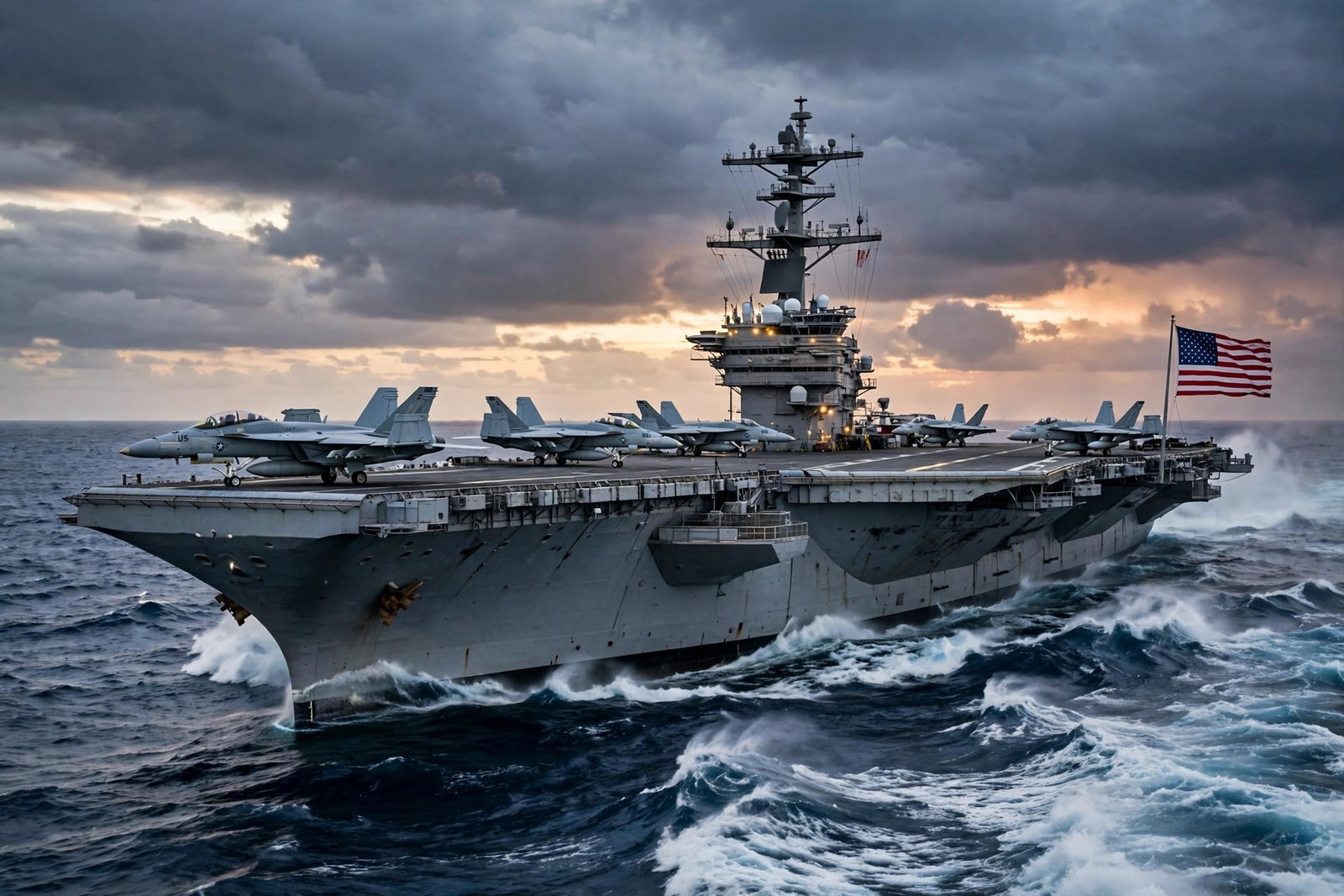
That reach is what allows the US Air Force to project power on a global scale and what keeps American aircraft carriers and their strike groups supplied and supported wherever they sail. The bases, the ships, and the aircraft are three parts of a single system.
Life Inside America’s Overseas Bases
For the hundreds of thousands of American service members, civilians, and family members who live on them, overseas bases are not just military installations — they are small slices of America transplanted abroad. A large base like Ramstein or Camp Humphreys has its own schools, hospitals, shopping centers, restaurants, and neighborhoods. Children attend Department of Defense schools, families shop at the commissary, and Friday night football games feel a lot like the ones back home.
At the same time, these bases are deeply woven into the economies and daily lives of their host communities. Local workers staff many base jobs, local businesses serve American customers, and cultural exchange flows in both directions — from the bratwurst stands outside German bases to the Okinawan festivals that American families attend in Japan. Many service members describe an overseas tour as one of the most eye-opening experiences of their lives, a chance to see the world while serving their country.
That closeness can also create friction. Noise, traffic, and the occasional crime involving American personnel have sparked protests in places like Okinawa, where a large share of the US presence in Japan is concentrated on a small island. Balancing the strategic value of the bases with the concerns of local residents is a permanent challenge for American diplomats and military leaders alike.
The Debate Over America’s Overseas Military Footprint
Few topics in American foreign policy inspire as much disagreement as the global network of American military bases overseas. Supporters argue the bases are one of the great bargains in American history: for a fraction of the defense budget, they deter wars, protect trade routes, and give the United States influence in every region that matters. They point out that the post-1945 era of American forward deployment has coincided with an unprecedented period without great-power war.
Critics counter that the network is a relic of the Cold War that no longer matches today’s threats. They argue that permanent bases create resentment, make the United States a target, and commit American troops to other countries’ conflicts. Some propose replacing large permanent garrisons with smaller, more flexible arrangements — a debate that has played out in Washington for decades and shows no sign of ending.
What both sides agree on is that the footprint is unique. No other nation has ever attempted anything on this scale, and none is close to matching it today. Whether that is a source of pride or a cause for concern depends on your view of America’s role in the world — but the bases themselves, from the flight lines of Kadena to the piers of Rota, are not going anywhere soon.
Conclusion: The Backbone of American Power
The story of US military bases worldwide is ultimately the story of how America became a superpower — and how it stays one. Eighty years after World War II, the network of hundreds of installations across dozens of countries remains the physical foundation of American influence: the runways, ports, radars, and barracks that turn military power from a promise into a reality.
Love them or question them, these bases shape the lives of millions of Americans in uniform and billions of people around the globe. They are the quiet infrastructure of the American century — and understanding them is the first step to understanding the power of the USA itself.
Want to understand American power even better? Explore more stories about the forces, technology, and history behind the USA’s global reach right here on Beauty of USA — and share this article with anyone who has ever wondered what those bases beyond America’s borders are really for.