
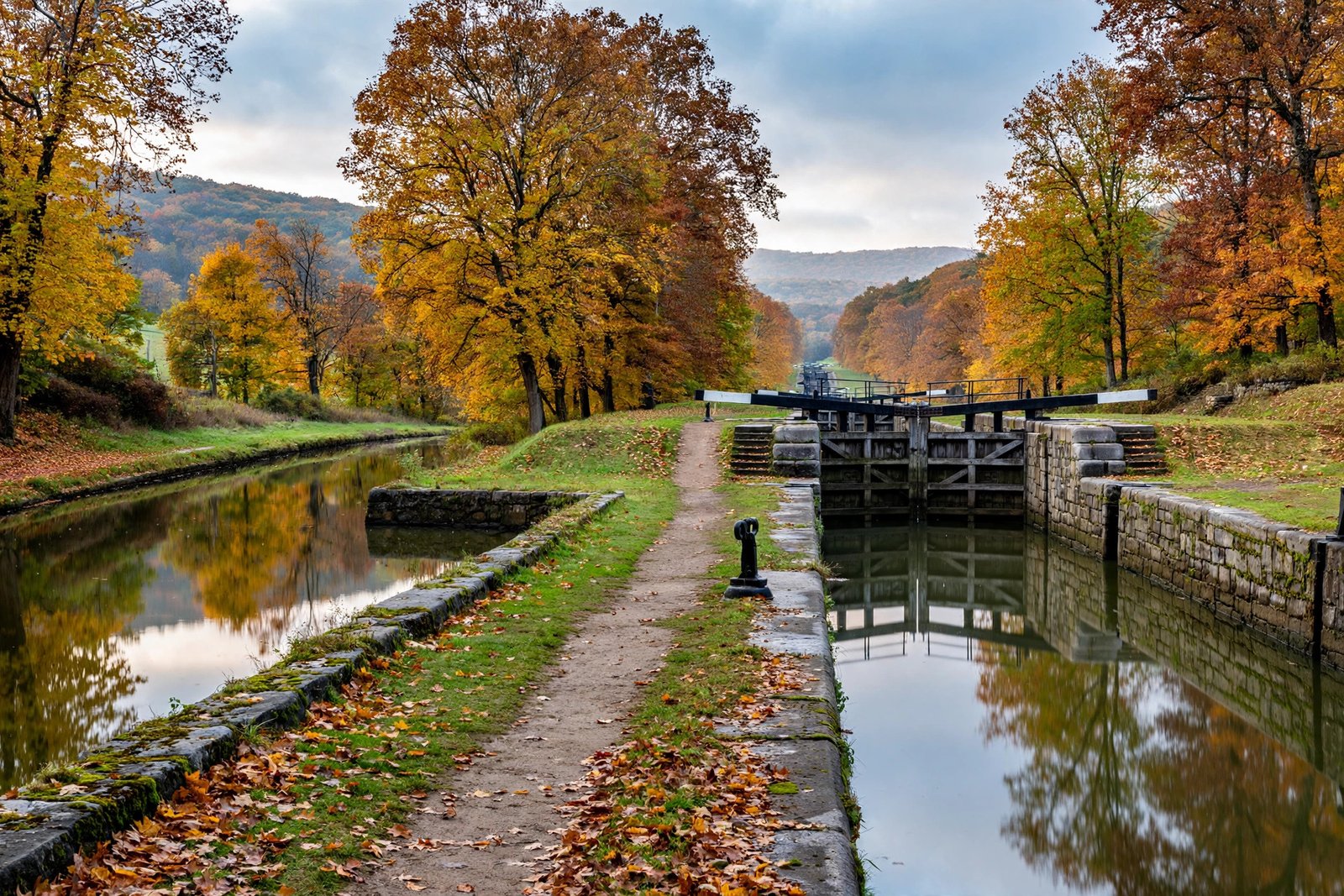
Two hundred years ago, traveling from New York City to the Great Lakes took weeks of slow, muddy, and expensive overland travel. Then a ditch dug by hand across New York State changed everything. This Erie Canal history shows how a bold idea, thousands of workers, and a simple waterway helped turn a young nation into a continental power, built great cities, and opened the American interior to farms, factories, and families looking for a new life.
Today, the Erie Canal is quieter than in its busy heyday, but its story is still written across New York. You can walk its towpaths, ride a bike along its trails, watch boats pass through old locks, and visit canal towns where warehouses, churches, and main streets still show the prosperity the canal once brought. For anyone who loves American history, the canal is one of the best stories in the country, because it is a story about ambition, hard work, and ordinary people doing something many experts said could not be done.
Erie Canal History: How the Idea Was Born
The idea of a canal across New York State grew from a simple geography problem. The Hudson River flows north from New York City to Albany, but from Albany westward, travelers faced mountains, forests, and rough roads. The Mohawk Valley offered the only relatively low gap through the Appalachian Mountains, and early leaders dreamed of linking the Hudson River to Lake Erie by water. Such a link would connect the Atlantic Ocean to the Great Lakes and, through them, to the growing settlements of the Midwest.
One of the most famous early supporters was DeWitt Clinton, who served as governor of New York and became the canal greatest champion. Critics mocked the plan as Clinton Big Ditch and said it would cost too much, take too long, and never work. Clinton and other supporters argued that cheaper transport would pay for the canal many times over, by letting farmers ship grain east and letting manufactured goods travel west at a fraction of the old overland cost. New York State eventually agreed to build the canal with state funds, a bold decision for its time.
A key part of this Erie Canal history is that American engineers had little experience building a canal of this size. The United States had built short canals before, but nothing 363 miles long with dozens of locks, aqueducts, and reservoirs. Young surveyors and engineers learned on the job, using simple tools, careful leveling, and trial and error. Their success became a training ground for a generation of American civil engineers who later built railroads, bridges, and other canals across the country.
Building the Impossible Ditch
Construction began on July 4, 1817, near Rome, New York. Workers dug by hand with picks, shovels, and wheelbarrows, and used horse-drawn scrapers and stump pullers to clear forests and roots. In wet areas, they built embankments and drainage systems. In rocky areas, they blasted with black powder, dangerous work done with great care. Much of the labor was done by local farmers in winter, when farm work was slow, and by immigrant workers, including many Irish laborers, who lived in rough camps along the route.
The canal had to climb about 565 feet from the Hudson River at Albany to Lake Erie at Buffalo, so engineers built locks, which are water chambers that raise and lower boats step by step. The original canal had 83 locks. Each lock was built of stone and wood, with gates that held back water while a boat entered, then filled or emptied to match the next level. At Lockport, a famous flight of five paired locks lifted boats up a steep limestone ridge, and the site remains a popular historic attraction today.
Aqueducts carried the canal over rivers and streams. The most famous early aqueduct crossed the Genesee River at Rochester, letting canal boats float high above the river valley. Workers also built reservoirs to feed water into the canal, towpaths beside the channel for mules and horses pulling boats, and bridges for roads and farms to cross. The work was slow, muddy, and often unhealthy, with malaria and other diseases in low, wet sections, but the line of the canal moved steadily westward year by year.
- Construction started July 4, 1817, and the canal opened in 1825.
- The original canal ran about 363 miles from Albany to Buffalo, New York.
- The original canal used 83 locks to climb about 565 feet from the Hudson River to Lake Erie.
- Canal boats were pulled by mules or horses walking on a towpath beside the water.
- The canal was later enlarged and improved several times, and parts remain in use today as part of the New York State Canal System.
The Grand Opening and the Wedding of the Waters
On October 26, 1825, the Erie Canal opened for full travel from Albany to Buffalo. Governor DeWitt Clinton traveled the route aboard the packet boat Seneca Chief, and celebrations took place in towns along the way. When Clinton reached New York Harbor, he poured a keg of Lake Erie water into the Atlantic Ocean in a ceremony called the Wedding of the Waters, symbolizing the union of the Great Lakes with the sea. Cannons fired along the route to carry the news, church bells rang, and parades celebrated what many saw as a triumph of American energy and planning.
The economic effect was swift and dramatic. Freight that once had to travel by wagon over rough roads could now move by boat far more cheaply and reliably. Farmers in western New York and the Ohio Valley could ship wheat, corn, lumber, and other products east to New York City, while manufactured goods, tools, and settlers could travel west. New York City grew rapidly as a port and commercial center, helped in large part by its new water link to the interior, and it soon became the largest city in the nation.
Travel also became easier for ordinary people. Packet boats, pulled at a steady walking pace by mules, carried passengers in relative comfort compared with stagecoaches. Travelers could sleep in cabins, eat meals on board, and watch farms, forests, and new towns pass by. For many immigrants and settlers heading west, the canal was the first leg of a journey to a new home.
Erie Canal History and the Towns It Created
One of the clearest legacies in this Erie Canal history is the string of towns and cities that grew up along its banks. Before the canal, much of western New York was forest and scattered farms. After the canal opened, towns such as Syracuse, Rochester, Utica, and Buffalo grew quickly as places where goods were loaded, stored, processed, and traded. Syracuse became known for salt production, Rochester for flour milling powered by the Genesee River falls, and Buffalo as the western gateway where lake ships met canal boats.
Canal towns developed a distinctive look that visitors can still see today. Warehouses stood close to the water, with loading doors facing the canal. Main streets filled with shops, hotels, churches, and homes for merchants, boat captains, and workers. Many towns built handsome downtown buildings in the nineteenth century, and preservation efforts have kept many of those streets lively with restaurants, museums, and festivals.
The canal also shaped settlement far beyond New York. Because the canal made travel to the Great Lakes cheaper, settlers moved in larger numbers to Ohio, Michigan, Indiana, Illinois, and Wisconsin. Farms in the Midwest fed growing eastern cities, and eastern factories supplied western farms. In this way, a New York waterway helped bind the young nation together, east and west, at a time when travel and communication were still slow and difficult.
Life Along the Canal: Mules, Boats, and Canal Towns
Daily life on the canal had its own rhythm, sounds, and characters. A typical canal boat was long and narrow to fit the locks, with a cabin for the captain family or crew, space for cargo, and a deck where mules drivers walked or rode. Mules, favored for their strength and sure footing, walked the towpath in teams, pulling the boat by a long towline. A boat captain would call out warnings at bridges and locks, and children known in folklore as hoggees sometimes helped drive the mules, though real canal work was hard for everyone, young and old.
Canalside life included lock tenders who opened and closed gates, toll collectors who charged fees based on cargo, blacksmiths who shod mules and repaired boats, and innkeepers who fed and housed travelers. Towns held fairs, markets, and church socials, and canal workers shared songs, stories, and jokes that later became part of American folklore. The famous song Low Bridge, Everybody Down, also known as Fifteen Miles on the Erie Canal, was written much later, in the early twentieth century, but it captures the nostalgic image of mule-drawn boats that many Americans still associate with the canal.
Not all canal life was romantic. Work was dangerous, wages were modest, accidents happened at locks and bridges, and disease spread in crowded, low-lying camps. Women and families lived aboard some boats, cooking, cleaning, and helping with lines and locks in all weather. Remembering both the romance and the hardship gives a fuller, more honest picture of the people who built and used the canal.
Expansion, Railroads, and Decline
Success brought demand for a bigger canal. In the nineteenth century, New York enlarged the Erie Canal, widening and deepening the channel and rebuilding locks to handle larger boats and more traffic. Later, in the early twentieth century, the state built the New York State Barge Canal, using natural rivers and lakes for much of the route and adding larger, modern locks. This system still exists today, though it carries far less commercial freight than it once did.
Railroads eventually took over much of the freight and passenger traffic that the canal once carried. Trains were faster, ran year-round, and could reach places canals could not. By the late nineteenth century, rail lines paralleled the canal route and offered quicker service, and the canal share of trade declined. The canal never disappeared, however. It continued to carry bulk goods such as grain and stone, and it remained an important waterway for local industry and recreation.
The decline of commercial canal traffic did not erase the canal impact. Cities founded or boosted by the canal remained, farms and factories built around canal trade endured, and New York City position as a leading port was already secure. The canal had done its main work: it proved that large public works could transform a region, and it helped set the pattern for later American infrastructure projects.
The Canal Today: Parks, Trails, and Cruises
Today, the Erie Canal is best experienced as a heritage and recreation corridor. The Erie Canalway National Heritage Corridor, designated by Congress, stretches across New York and helps preserve canal sites, tell canal stories, and support local communities. Visitors can explore museums in towns such as Syracuse, Rochester, and Lockport, see restored locks, walk along former towpaths, and learn how the canal was built and used.
For outdoor lovers, the canal trail system is a highlight. Large sections of the old towpath are now part of a multi-use trail where people walk, run, and ride bicycles for miles through farmland, villages, and historic downtowns. The Empire State Trail includes the Erie Canalway Trail as a major section, making it possible to plan long bike trips across New York with canal history at every stop. Boaters can still travel parts of the modern canal system, passing through locks and under lift bridges, a slow and memorable way to see the state.
Festivals keep the canal spirit alive. Towns along the route hold canal days, concerts, boat shows, and heritage events each summer, celebrating local history with food, music, and family activities. If you enjoy historic American journeys, a canal trip pairs well with other classic routes. For a famous road trip contrast, see our Route 66 road trip guide, and for charming stops in small communities, see our guide to the most beautiful small towns in America.
Another way to appreciate this Erie Canal history is to stand at a lock and watch the water do its quiet work. Gates close, water rises or falls, and a boat moves gently to the next level, just as boats did nearly two centuries ago. It is a simple machine, powered by water and gravity, and it still feels like a small miracle. That feeling is why the canal continues to draw visitors, students, cyclists, and boaters long after its commercial peak.
Plan a visit to the Erie Canal on your next trip to New York State. Start in Albany, Buffalo, or a canal town in between, visit a canal museum, walk a towpath, and take a boat ride if you can. Share the story with family and friends, and remember that a ditch dug by hand across a state helped build a nation. The Erie Canal is not just a historic waterway, it is a reminder that bold ideas, patient work, and public investment can change the map of a country for generations.