
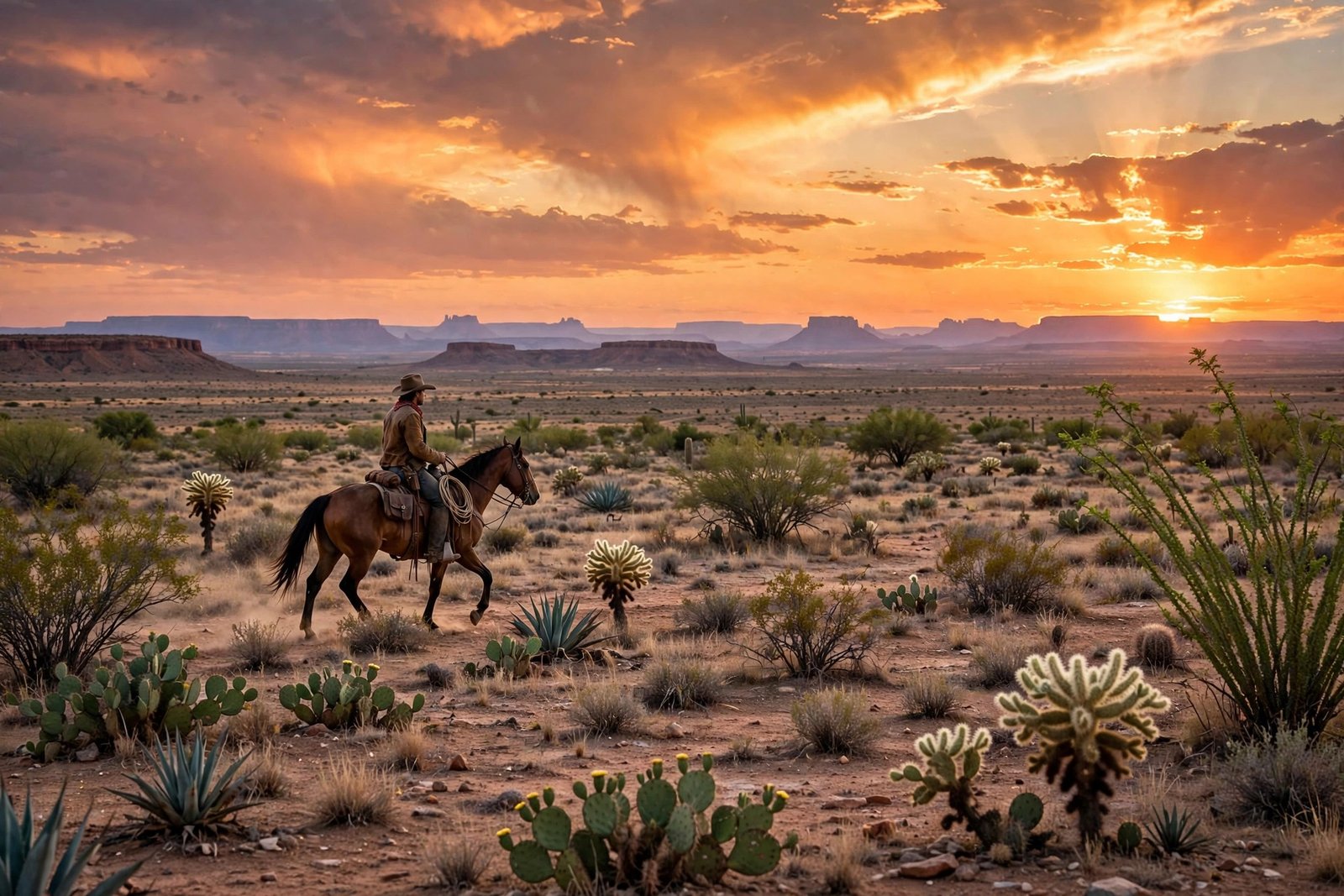
They say Pecos Bill was raised by coyotes, rode a tornado the way other cowboys rode horses, and once lassoed the entire Rio Grande just to prove he could. If you have ever wondered where those wild stories came from, you are about to meet one of America’s greatest tall tale heroes. The Pecos Bill legend is not a true story, and that is exactly the point. It is a celebration of the wide-open American West, told big on purpose, and it has entertained readers, listeners, and moviegoers for a century.
Unlike historical figures whose lives can be traced through records and newspapers, Pecos Bill belongs to folklore. He is a larger-than-life cowboy invented to capture the spirit of the frontier: brave, funny, stubborn, and impossibly skilled. In this guide, we separate the legend from the facts, retell his most famous adventures, and explain why Texans and storytellers across the United States still love him today.
Who Was Pecos Bill? The Pecos Bill Legend Begins
According to the stories, Pecos Bill was born in Texas in the days when the frontier was still wild and unsettled. As a baby, so the tale goes, he fell out of his family’s covered wagon while crossing the Pecos River country, and he was found and raised by a pack of coyotes. He grew up running with the animals, learning their ways, and speaking their language. That strange childhood is meant to explain everything that came later: his toughness, his closeness to the land, and his total fearlessness.
When Bill finally met other people, the stories say, he was already a remarkable young man. He could ride anything, rope anything, and out-talk anyone. He became a cowboy, and then the greatest cowboy of all time, at least in the world of tall tales. His horse was named Lightning, and his sweetheart was a fearless rider named Slue-Foot Sue. His sidekick in some versions was a giant, loyal companion, and his enemies included everything from outlaws to rattlesnakes to the weather itself.
It is important to say plainly: none of this is history. The Pecos Bill legend is folklore, a fictional character built from frontier humor, not a real person whose life can be verified. That distinction matters, because tall tales were never meant to be believed literally. They were meant to be enjoyed, exaggerated at every retelling, and passed along around campfires and dinner tables.
How Pecos Bill Was Created
So where did Pecos Bill actually come from? The character first appeared in print in the 1920s, in stories written by American author Edward O’Reilly. O’Reilly claimed he had heard the tales from old-time cowboys, but most scholars today agree that he largely created Pecos Bill himself, drawing on the tall tale tradition and the colorful storytelling culture of the West. In other words, Pecos Bill was born as literature dressed up as folklore, and audiences loved the trick so much that the character took on a life of his own.
The stories grew from there. In 1937, author James Cloyd Bowman published a children’s book called Pecos Bill: The Greatest Cowboy of All Time, which helped make Bill a household name for young readers. Later, Walt Disney brought him to the screen in the 1948 film Melody Time, where Pecos Bill’s adventures were retold in song and animation for a whole new generation. Each version added details, jokes, and exaggerations, which is exactly how folklore is supposed to work.
If you enjoy this kind of story, you will also love the other giants of American folklore. Read our guide to Paul Bunyan, the giant lumberjack whose axe supposedly carved out lakes and valleys, and the story of John Henry, the steel-driving man who raced a machine. For a broader look at which parts of these tales have real roots, see American legends and the true stories behind them.
The Tall Tales That Made Pecos Bill Famous
The heart of the Pecos Bill legend is a string of impossible feats, each one taller than the last. Here are the adventures storytellers return to again and again:
- Riding a tornado. In the most famous tale, Bill lassos a tornado and rides it like a bucking bronco until it runs out of steam. The story ends with the tornado’s rain falling across the Southwest, which the tale claims explains the region’s desert landscape.
- Taming the wild West. Bill is said to have dug the Rio Grande, or at least to have helped shape it, and to have wrestled bears, mountain lions, and rattlesnakes as casually as other people shake hands.
- Inventing the lasso. One story credits Bill with inventing the lasso itself, after getting tangled up in a rattlesnake that had wrapped itself around him. He supposedly turned that accident into a tool every cowboy would use.
- Riding Lightning. His horse, Lightning, was no ordinary animal. In the tales, Lightning could outrun anything on four legs and was almost as famous as Bill himself.
- Outsmarting outlaws. In story after story, Bill faces down gangs of cattle rustlers and bandits, usually without breaking a sweat, and often with a joke ready for the finish.
Notice the pattern: every feat takes something real about cowboy life, riding, roping, wrestling with the land, and stretches it until it becomes comedy. That is the tall tale formula. The stories were a way for people living hard lives on the frontier to laugh at hardship, celebrate skill, and imagine a hero who could never be beaten by drought, distance, or danger.
Slue-Foot Sue and the Most Famous Ending
No retelling of the Pecos Bill legend is complete without Slue-Foot Sue. In the stories, Sue was a cowgirl as bold and talented as Bill himself. She rode a giant catfish down the Rio Grande as her wedding entrance, wearing a steel-spring bustle that let her bounce, and that bounce is what made the ending famous.
According to the tale, Sue bounced so high, and kept bouncing higher with every landing, that Bill faced an impossible choice. He could not catch her without getting bounced himself, and he could not watch her bounce away forever. In most versions, he finally had to shoot her, or lasso her, to stop the bouncing, and the tragedy of that ending is played as both funny and sad. In the Disney version, the story softens the blow: Sue lands safely on the moon, and Bill, heartbroken, rides away to join the coyotes again.
Whether you prefer the bittersweet ending or the gentler one, Sue matters because she is not a background character. She matches Bill feat for feat, and her story reminds readers that tall tales could celebrate daring women as well as daring men. She has become a folk hero in her own right, and many modern retellings give her even more of the spotlight.
Pecos Bill Legend vs Fact: What Is Real?
Because the Pecos Bill legend feels so rooted in Texas, it is easy to wonder how much of it is true. Here is the honest breakdown:
- Real: the Pecos River, the Texas frontier, the cowboy way of life, the tall tale storytelling tradition, and the authors and films that spread the stories.
- Legend: Pecos Bill himself, his coyote childhood, his tornado ride, his giant feats, Slue-Foot Sue, and his horse Lightning. All fictional, all meant as entertainment.
- In between: the spirit of the stories. The courage, humor, and independence Bill represents were qualities that real frontier people admired, even if no single person embodied them all at once.
That mix is what makes tall tales worth reading. They are not history lessons, but they are cultural history: they show what Americans of a certain era dreamed about, laughed about, and wanted to believe about themselves. You can learn more about the character’s background from the Texas State Historical Association’s entry on Pecos Bill and from Britannica’s overview of Pecos Bill.
Why Pecos Bill Still Matters Today
A century after his first printed stories, Pecos Bill still shows up in children’s books, cartoons, theme parks, and Texas classrooms. Part of the reason is simple: the stories are fun. A hero who rides a tornado is hard to forget. But there is a deeper reason too. In a time when the American West was changing fast, with fences, railroads, and towns replacing open range, tall tales kept the frontier spirit alive in imagination even as it faded in daily life.
Today, the Pecos Bill legend also offers a useful lesson in media literacy. It shows how a story can feel old and authentic while actually being a recent invention, and how retelling can turn fiction into something that feels like tradition. That does not make the stories less valuable. It makes them more interesting, because they reveal how folklore is made, not just inherited.
For families, Pecos Bill is also a perfect introduction to American storytelling. The tales are funny, family-friendly, and easy to retell, and they open the door to other tall tale heroes, regional legends, and the real history of the American West. Start with one story at bedtime, and you will probably find yourself inventing a few tall tales of your own by morning.
Conclusion: Ride the Legend, Know the Truth
The legend endures because it does two things at once: it makes us laugh, and it makes us think about what the frontier meant to America. Bill never lived, but the spirit he represents, bold, funny, and larger than life, is very real. So the next time someone tells you about the cowboy who rode a tornado, enjoy every impossible detail, and then share the real story behind the legend with someone else. Have a favorite Pecos Bill tale of your own? Tell it at your next campfire, and keep the tallest tale tradition in America alive.