
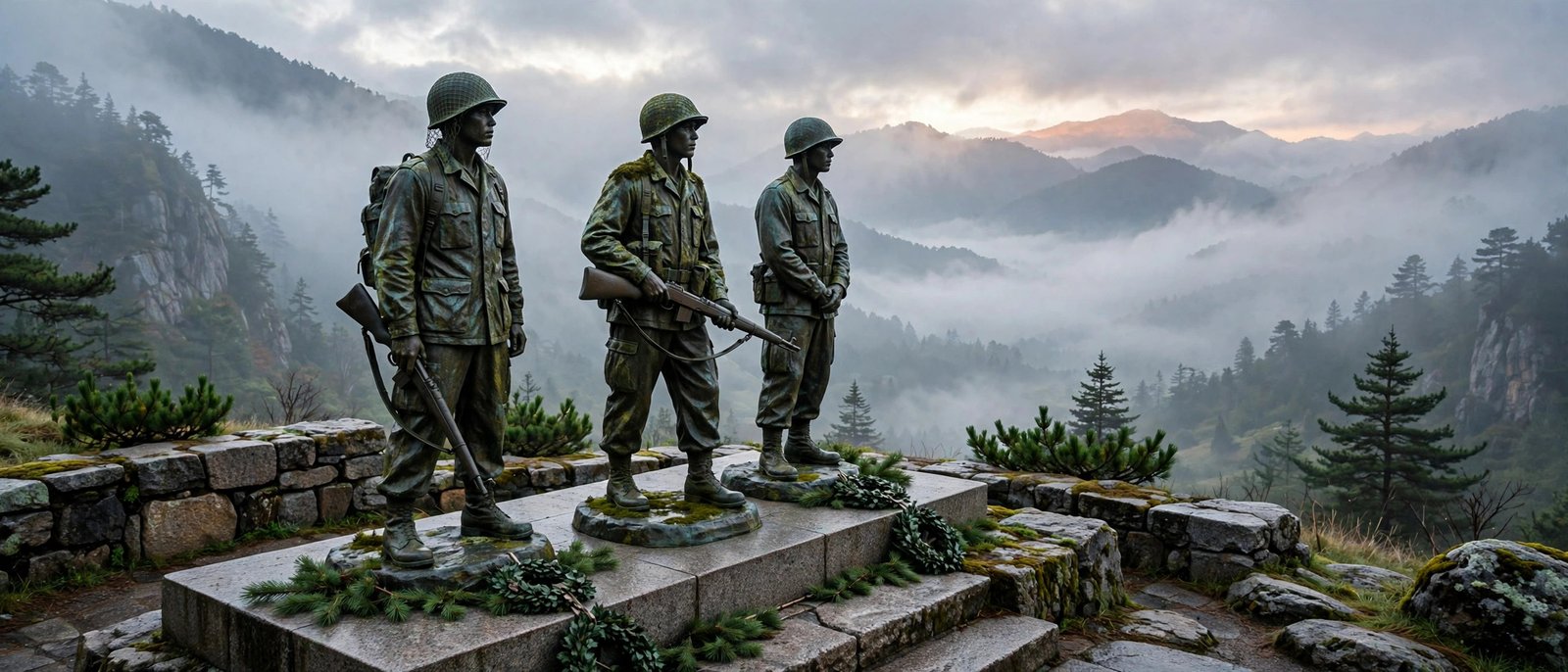
When people talk about the Korean War, they often call it the Forgotten War. Yet the Korean War true stories of the American soldiers who fought there are anything but forgettable. Between 1950 and 1953, young men from small farms, big cities, and every corner of the United States found themselves in a rugged, mountainous country on the other side of the world, fighting in bitter cold, monsoon rain, and blistering heat. They went as teenagers and young adults, many barely out of high school, and they came home changed forever. This is their story, told through the battles, the friendships, and the quiet acts of courage that defined a generation.
What makes Korean War true stories so powerful is not just the scale of the fighting, but the humanity inside it. Soldiers shared their last rations with Korean children, carried wounded friends for miles through snow, and held isolated hilltops against overwhelming odds. These were not characters in a movie. They were real Americans, and their experiences deserve to be remembered with honesty, respect, and care for the facts.
Korean War True Stories Begin on a Divided Peninsula
The story begins in the summer of 1950, when North Korean forces crossed the 38th parallel and invaded South Korea on June 25, 1950. The United States, acting with allies under the United Nations, rushed troops to defend the South. Many of the first American soldiers sent to Korea were occupation troops stationed in nearby Japan, and they were not prepared for the intensity of the fighting that followed. They faced a well-equipped enemy, difficult terrain, and a fast-moving front that shifted hundreds of miles in weeks.
In those early months, American units were pushed back to a small defensive perimeter around the port city of Pusan in the southeast. It was a desperate time, and the soldiers who held that line bought the time the United Nations needed to gather reinforcements. Their stand is one of the great stories of determination, because failure there could have meant the loss of the entire peninsula.
The Landing at Inchon: A Bold Gamble
One of the most famous episodes is the amphibious landing at Inchon in September 1950. General Douglas MacArthur planned a daring attack far behind enemy lines, at a port known for extreme tides and narrow channels. Many officers thought the plan was too risky. The Marines who carried it out proved otherwise. On September 15, 1950, American forces stormed ashore at Inchon and, within days, recaptured the capital city of Seoul.
The Inchon landing changed the course of the war. It cut off North Korean supply lines and allowed United Nations forces to push north. For the Marines and soldiers involved, it was a moment of triumph after months of retreat. Veterans of Inchon often remembered two things: the chaos of the landing itself, and the sight of Korean civilians welcoming them as they moved through liberated towns. Those memories stayed with them for the rest of their lives.
Frozen Courage at the Chosin Reservoir
Some of the hardest fighting came at the Chosin Reservoir in the winter of 1950. In late November, American Marines and soldiers found themselves surrounded by large Chinese forces in the mountains of North Korea, in temperatures that fell far below freezing. Weapons jammed, food froze solid, and frostbite injured as many men as bullets did.
The fighting withdrawal from the reservoir, often called the Battle of Chosin Reservoir, lasted about two weeks. The Marines fought their way south to the sea, bringing their wounded and their dead with them. Their discipline under impossible conditions became legendary, and the men who survived called themselves the Chosin Few, a name that captures both their pride and their loss. It remains one of the most honored chapters in Marine Corps history.
- The Chosin Reservoir battle took place in brutal winter cold in late 1950.
- Surrounded troops fought their way to the coast while carrying their wounded.
- Survivors became known as the Chosin Few, a name still used with pride today.
Holding the Line at Pork Chop Hill
After the front stabilized near the 38th parallel, the war became a grinding struggle for hills and outposts. Stories from this period are about endurance: weeks in muddy trenches, nights of artillery fire, and sudden attacks on small pieces of ground with names like Old Baldy, Heartbreak Ridge, and Pork Chop Hill. Pork Chop Hill, fought over in 1953, became a symbol of that bitter, close-quarters fighting.
Soldiers who fought on these hills described a strange mix of boredom and terror. Days passed with little action, and then, without warning, an attack would come in the dark. Men who had never met before the war became brothers in those trenches, and many veterans say the friendships they formed there were the strongest of their lives. That bond is a thread running through nearly all veterans’ memories.
Medics, Chaplains, and Nurses on the Front Lines
Not every hero carried a rifle. Medics ran into open fire to drag wounded men to safety, often while unarmed. Army nurses staffed mobile hospitals close to the front, working long shifts through waves of casualties. Helicopter evacuation, still new at the time, began saving lives that would have been lost in earlier wars, and the mobile army surgical hospitals of Korea later inspired a famous television series.
Chaplains also played a vital role, holding services in bunkers and comforting the dying. One of the most honored is Father Emil Kapaun, an Army chaplain who stayed with wounded men after being captured, and who died as a prisoner of war in 1951. He was later awarded the Medal of Honor. His story reminds us that courage in war takes many forms, and that faith and compassion mattered as much as firepower to the men on the line.
The Prisoner of War Experience and the Long Road Home
Thousands of American soldiers were taken prisoner during the Korean War, and their ordeal is among the most sobering chapters of the war. Prisoners endured harsh winters, poor food, and long forced marches, and many did not survive captivity. Those who did come home faced a different struggle: returning to a country that, unlike after World War II, did not greet them with parades. Many veterans simply went back to work, raised families, and rarely spoke about what they had seen.
That silence is part of why the war came to be called forgotten. It was not forgotten by the men who fought it, nor by the families of the more than 36,000 Americans who died there. In Washington, D.C., the Korean War Veterans Memorial now honors them with stainless steel statues of soldiers on patrol, a powerful tribute that visitors can see on a trip to the capital. For those planning such a journey, our guide to the best national parks in the USA and the most beautiful small towns in America can help shape a wider American road trip, including a stop at the memorial itself.
Why Korean War True Stories Still Matter Today
The armistice signed on July 27, 1953, stopped the fighting but did not formally end the war, and the peninsula remains divided to this day. South Korea, meanwhile, grew from a war-torn country into a thriving democracy and a close American ally, a transformation that veterans often point to with quiet pride. Their service helped protect that future, even if the victory was not as clear-cut as the ones their fathers celebrated in 1945.
Today, the generation of Korean War veterans is passing. Every year, fewer remain to tell their stories in person. That makes it more important than ever to listen, to record, and to share Korean War true stories accurately and with respect. Museums, oral history projects, and memorials all play a role, but so do families who sit down and ask a grandfather what he remembers, and write it down before it is too late.
If this story moved you, take a moment to learn more. Visit a memorial, read a veteran’s memoir, or share this article with someone who remembers the era. You can also plan a meaningful American journey with our Route 66 road trip guide, a classic route that many veterans themselves traveled on their way home. The best way to honor these heroes is simple: remember them, tell their stories truthfully, and never let their sacrifice fade from our national memory.